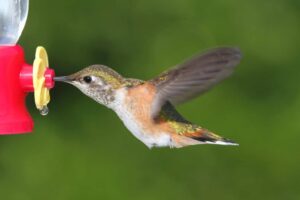
Many people say that hummingbirds only go to red flowers. This is, however, not completely true. This so-called “fact” is one of those pieces of garden advice that gets passed along and just keeps going, but it’s not really true. If you’re at a garden center and you have red salvia in one hand and a purple penstemon in the other, here’s the truth: the color of the plant is the least important factor to a hummingbird.

The Camera Feeder We Use In Our Own Backyard
See Today's PriceSave this article for later so you don't lose it. Enter your email and I'll send it to you now—plus you'll get my favorite backyard birding tips delivered to your inbox.
A hummingbird’s main considerations when choosing a plant are the plant’s shape, nectar depth, when the flower is in bloom, and how well the tube of the flower matches the bill length of the hummingbird. The five plants listed below have multiple and repeat visits from hummingbirds regardless of the climate and region they are in, and none of them are solely red. Once you recognize the trend, plant selection becomes much easier.
1. Red Columbine (Aquilegia canadensis): The Early-Season Secret Weapon

If you are trying to entice hummingbirds to your garden as early as possible in the gardening season, red columbine is the number one choice for you. It blooms in early to mid spring, which coincides with the migration of Ruby-throated Hummingbirds, when they arrive and need to refuel immediately. This becomes a huge factor that separates it from the other, more visually appealing plants that bloom in summer when food is readily available.
The elegance of the blooms is subtle and refined. The flowers are small and have long spurs that point backward, and the nectar is positioned to be the perfect depth for a hummingbird’s bill. The bird is able to hover below the flower and, with no effort, reach into the spur and get a drink. This engineering is specially made for hummingbirds to maximize their caloric intake since they burn calories at a rapid rate.
Columbine can be planted in partial shade with consistently moist soil (but not soggy). Unlike some of the other plants on this list, it does not tolerate dry spells as well. Because of this, a spot near a rain garden or along a north-facing border is a good option. If you let some seed heads remain at the end of the season, you will get new columbine plants filling in on their own over the next year or two.
Tubular Penstemon: Does ‘Husker Red’ Really Work?
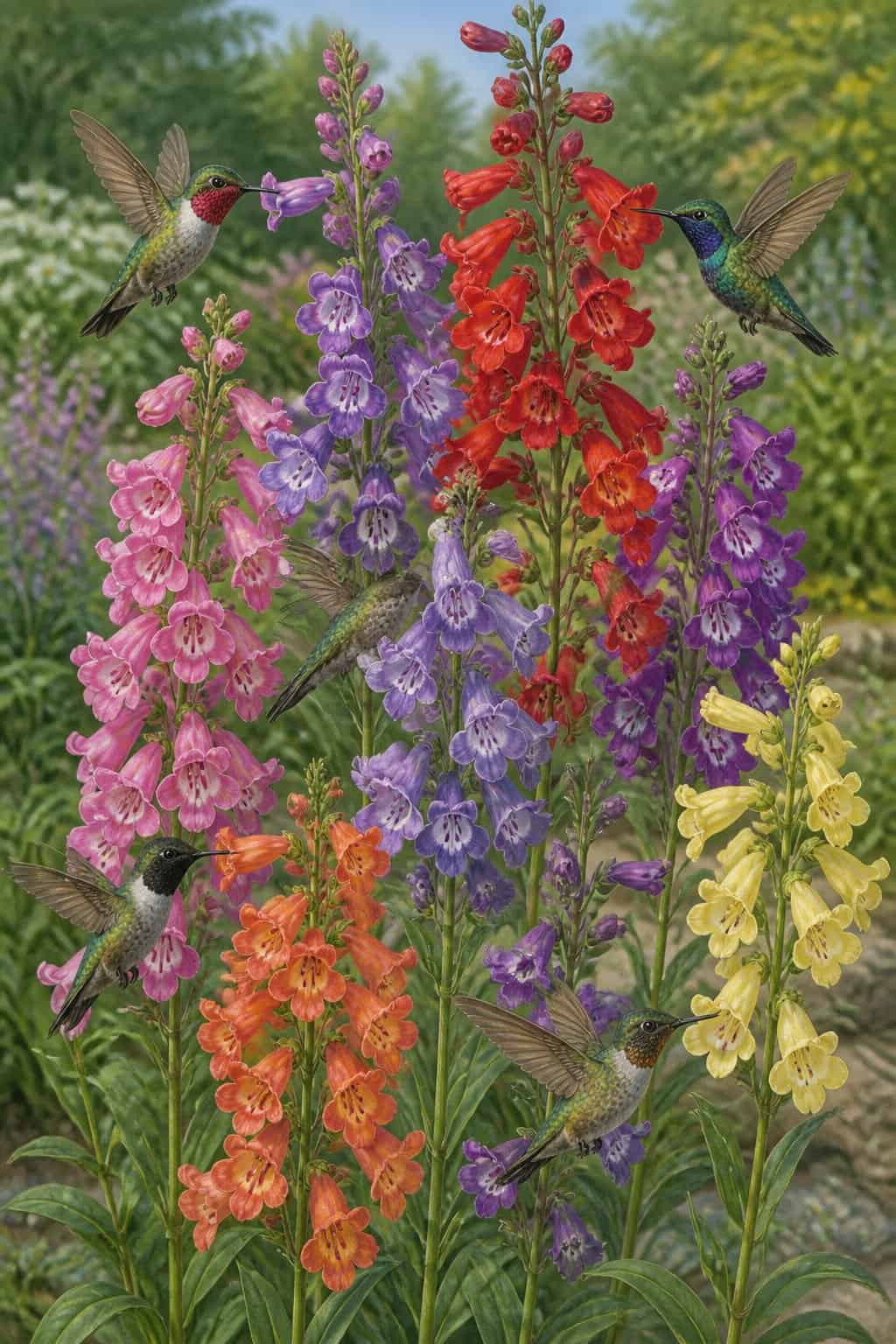
Yes, it really does. ‘Husker Red’ (Penstemon digitalis) is a native prairie plant that most people grow for its dramatic foliage, but hummingbirds show up for the flowers. The blooms are white with faint lavender throats, not red at all, and birds visit them consistently through late spring and early summer.
The tube length is almost perfectly calibrated for a hummingbird’s bill. Bees can access penstemon, too, which is actually a sign of a healthy pollinator garden, but hummingbirds tend to move through the spikes quickly and methodically, hovering at each tube in sequence. It’s satisfying to watch once you know what to look for.
Full sunlight and well-drained soil are a must. Penstemon hates winter wet feet more than almost anything else. Deadhead the spent flower spikes, and you will often get a second, smaller flush of bloom later in the season. Put it in a spot you can see from a window or patio, so you can enjoy the visits without disturbing the birds.
Group at least three to five of the same species together rather than mixing one of each plant. Hummingbirds are efficient feeders and prefer to work a reliable patch rather than hunt for scattered singles. A cluster of penstemon or columbine gets more repeat visits than the same number of plants spread across a large garden.
3. Coral Honeysuckle (Lonicera sempervirens): A Vine That Earns Its Space

Coral honeysuckle is one of those plants that rewards you with almost no effort once it’s established. The vines climb readily on a fence, trellis, or arbor, and the tubular blooms open in clusters from spring well into summer, with repeat flushes on and off through fall in warmer climates.
Unlike the invasive Japanese honeysuckle, this is a well-behaved native vine. The flowers are a coral to soft red orange and have a narrow enough diameter that they largely escape the attention of bees, keeping nectar available for the birds. This is not an accident, and plants that have co-evolved with hummingbirds have often developed tube dimensions that are suited to the birds.
If you live in a warmer climate, plant coral honeysuckle where it will receive morning sun and afternoon shade. Once established, it will tolerate quite a wide range of soil conditions. Planted near a path or a window, it will be easy to observe the wildlife it attracts. Give it something to climb right after planting, and then it will take care of the rest.

Florida Foliage Coral Honeysuckle Plants
Check PriceNative Trumpet Vine (Campsis radicans): Big Reward, Worth the Caution

Get our free Hummingbird Attraction Guide! Plus, we'll send you our best tips for attracting more birds to your yard.
Trumpet vine is like a fast-food drive thru for hummingbirds: high volume, high reward, and they return multiple times a day. The flowers are large, deeply tubular, and packed with a lot of nectar. In late summer, when many other blooms are winding down, trumpet vine is often still going strong.
This plant will spread and take over your garden. They have suckering roots and what might seem like a small manageable vine in year two can become a really big job by year five. You want to plant it on a very strong free-standing structure away from your house’s foundation and away from any fences you want to keep. Some gardeners find it works well to grow it in a large buried container to limit root spread.
After this is sorted, the investment pays off. Hummingbirds will use the trumpet vine as a feeding station and will often hang out in the leaves nearby. The blooms are a bright red-orange to orange-red color, which is very noticeable from a distance. When you have the right spot for them, very few plants get as much hummingbird traffic in a really small area.
“Shape, nectar depth, and bloom timing are what bring hummingbirds back repeatedly. Color is just the thing we notice first.”
5. Tubular Salvias Like Salvia coccinea ‘Lady in Red’

Salvias are one of the most dependable families for hummingbird gardens, and ‘Lady in Red’ is an excellent option to start with as it is easy to find, does well in heat, and flowers from late spring through hard frost in most zones. The individual flowers are small and tubular, located along upright spikes that sway easily in a breeze. Hummingbirds work up the spike methodically, which makes for genuinely entertaining watching.
Most tubular salvias are close to the right size for a hummingbird’s bill, so that the bird is able to get a very clean feed with no effort. That’s part of the reason the birds keep visiting the plant. Hummingbirds take a plant that provides nectar consistently at the right depth, like a reliable stop on their daily circuit.
Group salvias together near a feeder or existing perch. During dry spells, give them a light drink. They’re very forgiving and are perfect for use as a backup for a hummingbird planting scheme and will be beneficial for them.
Plan your bloom times for columbine in early spring, penstemon and coral honeysuckle in late spring, trumpet vine and salvias in late summer. If your yard has something blooming from April to October, your yard will be more attractive to hummingbirds.

Pase Seeds Salvia Coccinea Lady in Red
Check PriceWhy Hummingbirds Notice More Than Color

While color is an important factor for people when choosing plants, there are other things that may be more important for a hummingbird.
The Role of UV Patterns
Many tubular flowers create patterns that are visible only in ultraviolet light (UV light), which show where to find nectar. Hummingbirds tend to react more to the throat markings of flowers such as penstemon, which are subtle to humans, and they may see these markings as bright targets. Studies have shown that hummingbirds, as well as other pollinators, are more attracted to UV patterns than to the visible colors of flowers.
This explains why planting native species often works better than fancy hybrids for attracting wildlife. Cultivars that are bred for specific colors or double petals may lose UV signals, which makes them less appealing to hummingbirds and other pollinators, even when they look spectacular to us.
How Shape and Scent Influence Visits
In relation to a tube’s length, a hummingbird’s bill is an evolutionary adaptation that allows it to access nectar hidden in deep, narrow tubes, which, when compared to insect tongues that are shorter, provides nectar that is more readily accessible to other insectivorous competitors. This is an example of a co-evolved trait that developed over a long period of time, resulting in deep tubular flowers flourishing and often eclipsing the utilization of other non-tubular flowers by the foraging activities of hummingbirds that rely on deep tubes to obtain nectar.
While scent is not as significant as other stimuli, it is of some importance. For example, at certain times of the day, some tubular flowers produce scents (i.e., fragrances) that are imperceptible to the human nose, but that the birds can detect and indicate to the birds the presence of a novel source of sustenance. Once hummingbirds have found a flower and discovered its rewards, they will return to that flower again and again to access the nectar, as long as the flower is open (nectar available). They are creatures of habit that visit the same flower patch and follow the same schedule day after day.
Common Flower Myths That Beginners Hear

In every new beginner gardener community I have had the pleasure to be part of, two common myths pop up all the time, and I hope it is clear that I
Are Red Petals Really Necessary? Bee Balm (Monarda didyma) Says No
The perception that some plant species attract no hummingbirds can be challenged using bee balm as an example. Despite the fact that bee balm does exist in red and pink varieties, as well as lavender and white, hummingbirds flock to all of them. This suggests the color of the bloom is irrelevant. Instead, it is likely the case that the structure of the individual florets (flowers) in the bloom (head), as well as the nectar they hold, is what really attracts the hummers.
The unique, minty-herbal aroma of bee balm can be a delightful fragrance in the garden. The pleasant aroma is not the only reason to plant bee balm. Once established, the plant will spread to occupy a larger area, allowing for more blooms every season without the need for replanting. The best location for bee balm is in full sun, although areas with high humidity should be avoided, as they can cause powdery mildew. Air circulation can reduce the amount of mildew, as well as help maintain cleaner foliage throughout the season.
Do Hummingbirds Avoid Certain Colors? Trumpet Creeper (Campsis radicans) Clears This Up
The color of the blooms of the trumpet vine can be a myth-buster, as they bloom in shades of orange and sometimes yellow-orange. Supposedly, plants with blooms in these colors do not attract hummingbirds; however, trumpet creeper is among the most heavily visited plants by hummingbirds. The reason color is not as important as most people think is that the tubes of the trumpet creeper are deeper and have a higher concentration of nectar than other hummingbird plants.
When presented with the myth that red flowers are preferred to other colored flowers due to their nectar, many gardeners are disappointed. Once a hummingbird has visited an orange flower with richer nectar and deeper tubes, it can be expected that the “color” myth no longer holds its seductive appeal.
The best hummingbird garden has so many more important elements than just the presence of red flowers. The most important features include gardens that have long and consistent bloom seasons, deep nectar tubes, and consistent nectar availability.
Gardens that also have lots of variation in plant height and structure so that the birds can comfortably feed, perch, and rest throughout the day will see the most visitors. When all of these fundamentals come together, you can expect to see birds visiting plants that you never thought would attract them.
📷 Show us your feeder setup! Share a few photos of your feeders and you might be featured on Wild Bird Scoop. Share your setup →