Well, friends, I’ve been peering through my kitchen window like it’s Nature’s own television set for over four decades now, and let me tell you – our backyards are bustling with more feathered drama than most folks realize. While everyone can spot a cardinal showing off his crimson suit, there’s a whole cast of fascinating avian characters putting on a daily show that most people miss completely.

The Camera Feeder We Use In Our Own Backyard
See Today's PriceLet’s meet some of these overlooked stars of your backyard bird theater.
Save this article for later so you don't lose it. Enter your email and I'll send it to you now—plus you'll get my favorite backyard birding tips delivered to your inbox.
1. The Cedar Waxwing

The Cedar waxwing is a colorful, mid-sized bird boasting shades of gray, brown, and brilliant yellow. This bird’s most distinctive feature is the striking red wax droplet on its wing feather.
It also has a jet-black mask stretching from its eyes to the back of its head. Cedar waxwings will eat berries all year long, but sometimes add insects to their diet during spring.
They have a varied call of whistles, cheeps, and long, buzzy trills.
2. The White-Breasted Nuthatch

The White-breasted Nuthatch is a small bird with a big personality. At just four inches long, this little bird is easy to miss.
But those who take the time to get to know the White-breasted Nuthatch will quickly fall in love with its energetic and playful nature. The bird that hangs upside down on a bird feeder is most likely a nuthatch.
Nuthatches are attracted to bird feeders that offer sunflower seeds, nuts, or suet.
3. The Tufted Titmouse

The Tufted Titmouse whistles a very clear song that sounds like “Peter, Peter, Peter!” They will repeat this sound up to 11 times in a row — about 35 songs per minute! You’re most likely to hear males in the morning, but females will sometimes reply with a softer version of the same song.
The Tufted Titmouse is an adorable and tame bird most common in the east. They have a distinguishable song that sounds like someone is whistling the name “Peter” repeatedly.
4. The Carolina Wren
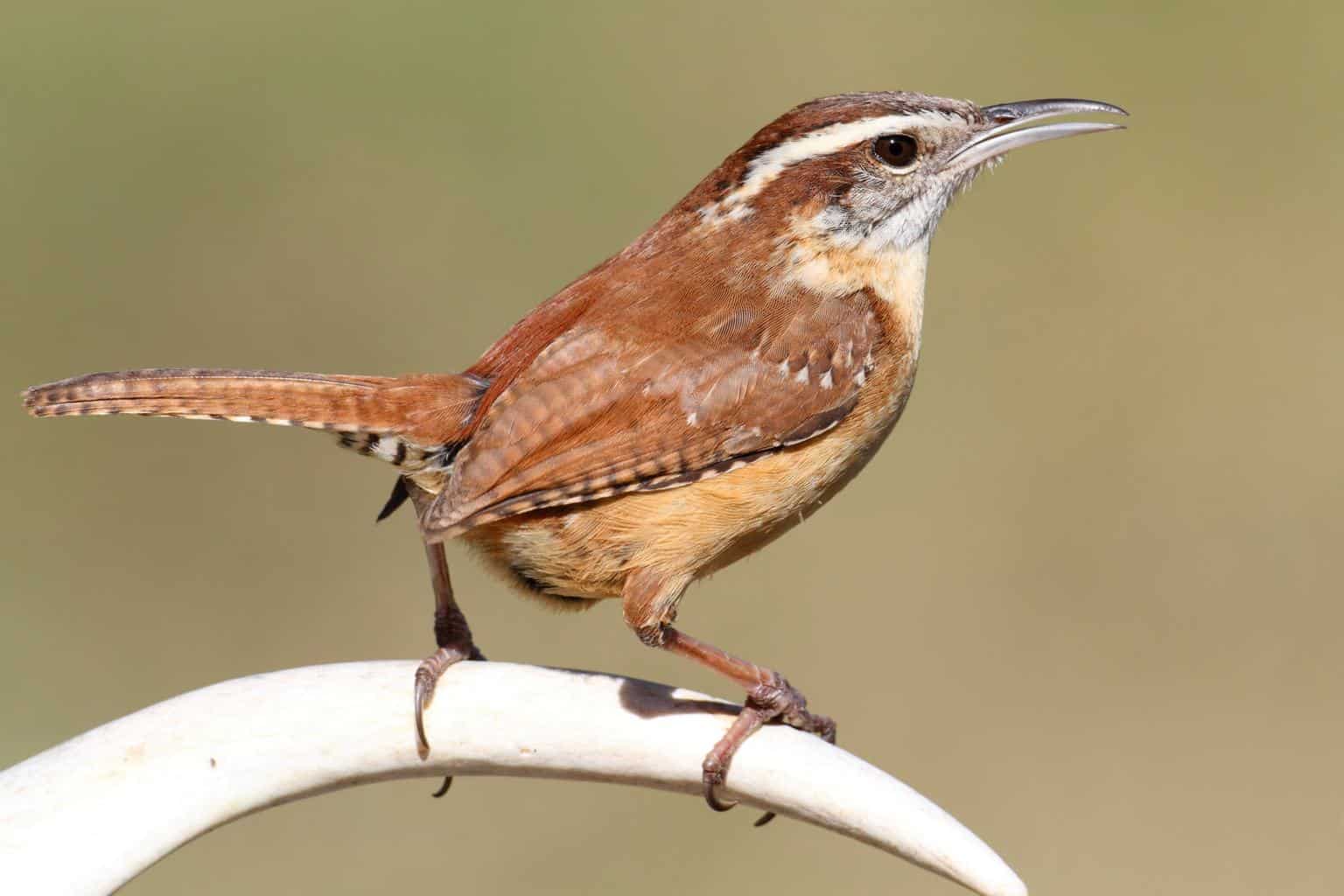
The Carolina Wren is reddish-brown in color, with white streaking on its wings and tail. It is small with a tail that points upward–one of the signature features of most wrens.
It sits upright, looking alert and attentive to its surroundings. Look for the long white eyebrow stripe if you are unsure if it’s a Carolina Wren or another small bird.
The Carolina Wren is cinnamon-brown with a short, upward-pointed tail and an upright posture. The easiest way to recognize the Carolina Wren is to look for its long, off-white eyebrow stripe that extends beyond the back of its head.
They are small and sexually monomorphic, so there are not any differences in the appearance of males and females.
5. The Dark-Eyed Junco

The Dark-eyed Junco is a plump little sparrow that is strongly associated with winter in much of North America. They are among the birds that are called “Snowbirds,” as they are so commonly spotted at snowy backyard bird feeders.
The Dark-eyed Junco is strongly associated with winter in most of the US. In fact, they are frequently called “Snowbirds” on account of their winter arrival and their presence at birdfeeders during the winter.
Get our free Hummingbird Attraction Guide! Plus, we'll send you our best tips for attracting more birds to your yard.
Even though lots of other sparrows are found in Pennsylvania during the winter, Dark-eyed Juncos are some of the most easily noticed!
6. The Red-Bellied Woodpecker
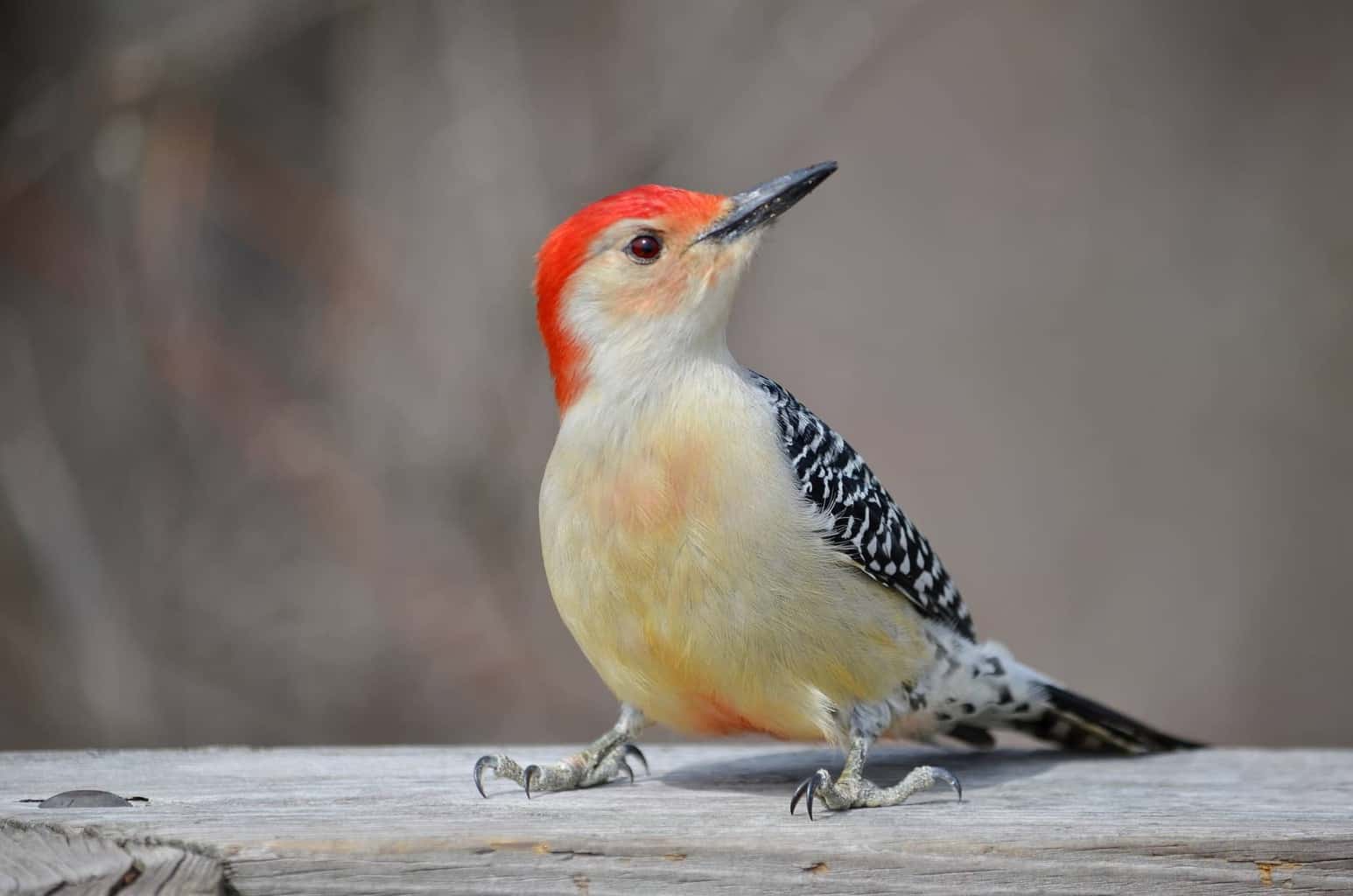
If you just go by their names, identifying red-bellied woodpeckers will be nearly impossible, as they barely have any red hues on their stomachs. You’ll have to look very closely at their bellies, and it’s only then that a very faint blush area can be seen.
At first glance, novice birdwatchers can mistake the red-bellied woodpeckers for their red-headed cousins. See, a red-bellied woodpecker doesn’t actually have a red belly!
Its underparts are colored in greyish-white with some pinkish spots.
7. The Eastern Phoebe

Eastern phoebes typically build nests under bridges or in cavities in trees. The eastern phoebe is a popular bird among birdwatchers.
8. The Brown Thrasher

The Cornell Lab says the brown thrasher, one of several thrasher species in America, “may be the champion mimic in North America” due to their ability to sing up to 2,000 different songs. The brown thrasher can mimic up to 2,000 different songs, according to the Cornell Lab of Ornithology.
The National Wildlife Federation reports that each northern mockingbird individual can learn up to 200 different calls in their lifetime.
9. The Pine Siskin

A glance at the pine siskin may have you thinking you’ve encountered a completely different bird species. These finches are among the smallest of the finch family and have a surprisingly tiny beak!
Both the male and female Pine Siskin display grey and brown plumage highlighted by patches of bright yellow. These small birds are especially prepared for the cold night air.
They have the unique and very useful ability to raise their metabolic rate up to 40% higher than other birds their size which helps them keep warm even in the coldest winds.
10. The Ruby-Crowned Kinglet

Colorado is home to two kinglet species, the ruby-crowned kinglet and the golden-crowned kinglet. The more spectacular of these might be considered the ruby-crowned kinglet when its ruby-red patch is visible.
This olive-colored bird is quite tiny, at just 3.5 to 4.3 inches in length. Its namesake ruby-colored crown is not always visible, but the shock of bright color is always a treat to spot.
11. The Yellow-Rumped Warbler

Unlike other warblers, the Yellow-Rumped Warbler can digest the waxes found in bayberries and wax myrtles. This gives the bird the energy to winter further in the north.
The yellow-rumped warbler perches on trees’ outer limbs in the summer, and if you offer food in the winter, it may visit your backyard. Keep your feeder stocked with suet, peanut butter, and black oil sunflower seeds and you just may be able to snap a few photos of these unique-looking birds as they feed at your home.
12. The Brown Creeper – The Bark Specialist

These fascinating little birds are nature’s wallpaper – their mottled brown coloring makes them nearly invisible against tree bark. Unlike nuthatches that work downward, creepers spiral upward around tree trunks with a distinctive hitching motion, like tiny mountaineers ascending a vertical face.
According to the Cornell Lab of Ornithology, their thin, curved bills are perfectly adapted for extracting insects and spiders from bark crevices that other birds can’t access.[12] I’ve spent many an afternoon watching them work their way up one tree, then fly down to the base of another to start their spiral climb all over again – nature’s original “rinse and repeat” instruction.
13. The Eastern Towhee

The Eastern Towhee feeds primarily on the ground, scratching the leaf litter to uncover insects, seeds, and berries. They have a unique foraging behavior where they perform backward and forward hops, uncovering hidden prey items.
The Eastern towhee has a special technique for finding seeds. It scratches the ground with both feet to find deeply buried seeds.
Some small animals are also part of this sparrow’s diet, like snakes, lizards, and some small amphibians.
14. The Purple Finch

Purple finches and house finches are often confused with one another in North America, but purple finches have more color, described by Roger Tory Peterson as a “sparrow dipped in raspberry juice,” via All About Birds. The male purple finch is sometimes referred to as being ‘dipped in raspberry juice’.
It’s an apt description because they’re covered in vivid reddish pink from head to toe.
15. The Fox Sparrow

Fox Sparrows are messy little birds. They kick up a lot of litter as they are looking for insects and seeds on the ground.
If you see leaves and dirt flying about under your birdfeeder, don’t be surprised if it’s a Fox Sparrow! Fox sparrows have several subspecies across North America, some of which are less red and more brown like the sooty, thick-billed, or slate-colored fox sparrows.
Maine’s fox sparrows are splotchy and red like the red fox that lends its name to this bird.
Overlooked backyard birds our writers describe
| Bird | What our writers say |
|---|---|
| Cedar waxwing | Red wingtips; berries year-round, insects in spring |
| White-breasted nuthatch | About four inches; hangs upside down for sunflower, nuts, or suet |
| Carolina wren | Reddish-brown, tail pointed up, bold white eyebrow |
| Dark-eyed junco | Called a snowbird for its winter arrival |
| Brown thrasher | Cornell calls it a champion mimic; up to 2,000 songs |
| Ruby-crowned kinglet | 3.5 to 4.3 inches; the ruby crown is not always visible |
| Yellow-rumped warbler | Can digest bayberry and wax myrtle waxes, so it winters farther north |
| Eastern towhee | Scratches leaf litter with both feet for insects, seeds, and berries |
| Purple finch | Males look dipped in raspberry juice |
📷 Show us your feeder setup! Share a few photos of your feeders and you might be featured on Wild Bird Scoop. Share your setup →