Chipping Sparrows (Spizella passerina) are a familiar sight in North America. Their most distinguishing characters are a rufous colored crown and a prominent supercilium.

The Camera Feeder We Use In Our Own Backyard
See Today's PriceMost observers will see them foraging on the ground, but they engage in more interesting behaviors that are hidden among the leaves of shrubs and conifers. Chipping Sparrows are unrelenting builders of nests.
Save this article for later so you don't lose it. Enter your email and I'll send it to you now—plus you'll get my favorite backyard birding tips delivered to your inbox.
In just one summer, one breeding pair can build multiple nests, sometimes two, three, or even four.
The repeated construction of nests is primarily not due to poor craftsmanship, but instead indicates a sophisticated blend of biological necessity and environmental limitation. In order to unravel why chipping sparrows constantly rebuild nests, it is essential to analyze their breeding behavior, the intricate design of the nests, and the many threats that they face during the nesting season.
The Architecture of a Chipping Sparrow Nest
All of Ohio will see Chipping Sparrows settle in for the summer. They usually build their nests in conifer trees, although they will sometimes choose a deciduous tree or build a nest on the ground.
Many sparrows on this list avoid nesting more than a couple of feet off the ground, but Chipping Sparrows will nest up high if they need to. Chipping Sparrows are skilled nest builders, constructing cup-shaped nests using grass, fine twigs, and other plant materials.
Their nests are often located in trees or shrubs, as the cover provides protection from the elements and from predators.
The interior lining is the most distinctive feature of their architecture. Historically known as the “hairbird,” the chipping sparrow lines its nest almost exclusively with fine animal hair.
Before the advent of the automobile, horsehair was the preferred material. Today, they utilize hair from deer, domestic dogs, and even fine synthetic fibers.
While this lining provides excellent insulation for the eggs, the overall structure remains incredibly fragile and susceptible to damage from both weather and wildlife.
Reason 1: The Multi-Brood Biological Strategy
One of the primary drivers of the construction is bioprogramming. Like many birds, chipping sparrows are multi-brooded.
For the evolutionary survival of the species, the population’s short breeding time motivates the short breeding season phenomenon of producing multiple clutches. A successful pair typically rears two broods, although it is possible to have three successful broods in southern areas with longer summers.
Get our free Hummingbird Attraction Guide! Plus, we'll send you our best tips for attracting more birds to your yard.
Crucially, chipping sparrows rarely reuse an old nest. Once a brood successfully fledges, the original nest is often stretched out, soiled with droppings, and infested with avian mites or other parasites.
To give the next clutch the highest chance of survival, the female will abandon the old structure and build a completely new nest nearby, sometimes within a few feet of the original site.
Reason 2: Brood Parasitism by Brown-Headed Cowbirds
Not every instance of nest abandonment is an intentional act. The brown-headed cowbird is a notorious brood parasite and has a particular affinity for chipping sparrows.
Rather than building their own nests, female cowbirds will lay their eggs in the nests of other songbirds and obligate the host parents to care for, incubate, and rear the rather demanding cowbird chick.
Chipping sparrows show different responses to intrusions in behavioral studies. If female sparrows see a foreign egg or a cowbird removes one of the sparrow’s eggs, she will abandon the nest.
When a female sparrow abandons a nest, the pair has to start the entire breeding cycle over again. This means collecting different materials and building a new nest that is more concealed.
Reason 3: Environmental and Predatory Destruction
Most times, Chipping sparrows build their nests between 3 and 10 feet off the ground in shrubs or small evergreens. Because of the low height of the nests, there are many greater dangers that may threaten nests of Chipping Sparrows.
For example, woven grass, extremely delicate as summer thunderstorms come, can destroy nests. Also, poorly built nests can be blown away by strong winds.
Predation is an even bigger concern. Nesting locations that are lower in elevation are easier for a variety of predators to find.
For example, Rat snakes and garter snakes are egg thieves, and both domestic and feral cats hunt nestling and brooding adult birds. In addition, adult blue jays and American crows destroy chipping sparrow nests to feed on the eggs or nestlings.
If a nest is depredated, adult sparrows will start looking for a new site to renest immediately.
Timeline of a Three-Nest Season
To visualize how a chipping sparrow fits three distinct nesting attempts into a single season, field biologists track their activity from spring migration through late summer. The following table outlines a typical timeline for a highly productive pair.
| Month | Nesting Phase | Brood Number | Typical Outcome |
|---|---|---|---|
| Early May | First construction and incubation | Brood 1 | Often vulnerable to late spring storms or early cowbird parasitism. |
| Late May to June | Rebuilding and second clutch | Brood 2 | Highest success rate. Dense summer foliage provides better camouflage. |
| July | Final construction and incubation | Brood 3 | Attempted if previous broods failed or if the season is exceptionally warm. |
How Backyard Birders Can Help Protect Nests
Backyard birds face threats from lots of predators, both natural and unnatural. Among unnatural predators, cats are the most harmful to backyard bird populations, killing billions of birds per year.
If you own a cat, keep it inside or on a leash. While most damage is caused by community or feral cats, you can still do your part to control your cat and protect the birds in your yard.
While the cycle of building, failing, and rebuilding is a natural part of the chipping sparrow’s life, backyard bird watchers can take specific steps to support these prolific builders. Creating a safe habitat requires minimizing human interference and mitigating unnatural threats.
Humane Nest Observation and Support Checklist
- Keep your cats indoor. Keep your cats indoors to protect songbirds and sparrows as well. Your cats can cause a massive downfall in the population of Oconee Bell songbirds. Keeping your cats indoor will protect low nesting types of sparrow.
- Provide safe nesting materials: Brush out domestic dogs and leave the clean, untreated fur in a suet cage for sparrows to collect. Avoid leaving out human hair or synthetic yarns, which can tangle around the legs of nestlings.
- Please respect the space: If you come across a nest in a foundation shrub, please keep at least 20 feet from the nest. Animals, including predators, tend to find the nest as a result of frequent human visits.
- For now, it would be prudent to hold off on the aggressive pruning. Property owners should wait until late autumn or winter when pruning dense evergreens, junipers, and yews will not risk exposing or destroying active nests.
- Cowbird Feeder Management: If brown-headed cowbirds start dominating the backyard feeders, those monitoring the feeders should consider taking down the feeders for a few weeks to encourage the cowbirds to move to a different location, thus decreasing the likelihood of brood parasitism.
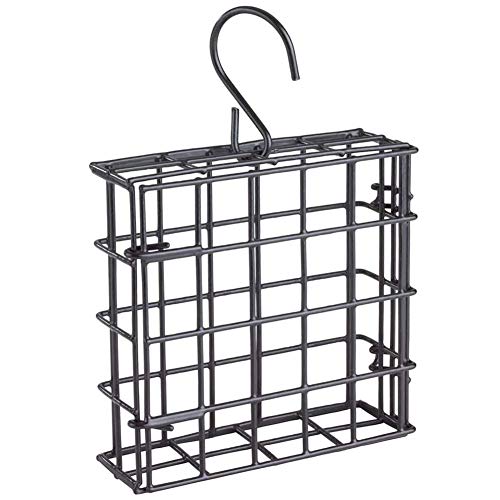
More Birds Suet Cage Bird Feeder Black
Check PriceConclusion: The Resilience of the Chipping Sparrow
Chipping sparrows have the ability to meet challenges head on by building multiple new nests during the nesting season. These small songbirds respond to the challenges, whether it is the instinctive need to rear another brood, the threat of a cowbird, or from a predatory attack.
This nesting behavior data, combined with some added protection to backyard habitats, enables bird lovers to assist these delicate nests lined with hair to rear another generation of sparrows into the world.
Chipping sparrow nest notes
| Spec | What our writers say |
|---|---|
| Ohio season | They settle in for the summer |
| Usual nest tree | Conifers, sometimes a deciduous tree, sometimes the ground |
| Height | They will nest high if they need to |
| Shape | Cup-shaped |
| Materials | Grass, fine twigs, and other plant materials |
| Cover | Trees or shrubs for weather and predators |
| Cats | The most harmful unnatural predator, killing billions of birds a year |
| Pet cats | Keep them inside or on a leash |
📷 Show us your feeder setup! Share a few photos of your feeders and you might be featured on Wild Bird Scoop. Share your setup →