The feeder may draw your attention, as each bird hushes suddenly like a wire was cut. This won’t happen at random and can be a biological or environmental shift that each bird has noticed. This can be anything from raptors to pressure drops to an invisible prey base collapse, and if someone knew what they were doing, these causes would reveal themselves within minutes.

The Camera Feeder We Use In Our Own Backyard
See Today's PriceSave this article for later so you don't lose it. Enter your email and I'll send it to you now—plus you'll get my favorite backyard birding tips delivered to your inbox.
While the quiet remains, watch the space. These trends can be tied to the weather, predation, or human influence. The nine explanations that follow detail these impacts as seen from behavioral studies and observation.
1) The Predawn Migratory Pause

Before first light, a yard can become quiet. The songbirds will also suddenly stop singing and the quiet can feel intentional.
Birds utilize stars, magnetic orientation, and infrasound when migrating. Evidence suggests that before migration, birds such as thrushes and warblers stop vocalizing to reduce masking and direct use of their internal migratory compass (Emlen 1975; Mouritsen 2019). This silence aids in the detection of faint celestial or geomagnetic cues and in the coordination of departure timing within a flock.
As landing birds begin feeding a few minutes post-sunrise, prepare for more songs. Observe which species quiet first. Long-distance migrants are most likely to stop, and this pattern will repeat on nights with good tailwind.
Thrushes and warblers have been documented using a kind of magnetic inclination compass that requires a window of silence to function at peak sensitivity. Vocal noise from the bird itself, not just external sound, can interfere with the internal signal processing used during nocturnal orientation flights.
2) A Hawk Silhouette Overhead

The yard suddenly grows silent; birds remain completely still, and every head looks up. Oftentimes, a shadow flies across the yard before the cause becomes known.
This is a hard-wired anti-predator response. Research on songbird alarm behavior shows that the song and movement of a group suddenly stop in the presence of raptors; collective stillness lowers their risk of detection and increases the possibilities for escape. Sharp-shinned and Cooper’s hawks, which are common near feeders, are especially effective in eliciting the freeze response, and they hunt by surprise and accelerate through thick cover. A moving bird is more readily pursued by a hawk than a still one.
If your goal is to identify the cause, look for a silhouette fitted with a fast and direct flight that shows gliding interspersed with rapid wing beats. Birds will retreat to the cover shrubs if they are near feeders within seconds. It is also generally effective to avoid placing feeders near tall, isolated perches, and to keep low dense shrubs nearby gives birds both sight lines and escape routes.
3) Wind Shift and the Collapse of Aerial Prey

An abrupt shift in the wind from southwest to northwest will quiet the yard in less than a minute. The usual chatter will disappear alongside the swifts, flycatchers, and swallows that stop hunting above the lawn.
Strong winds cause little insects to flee the hunting area or become trapped against vegetation, making aerial hunting inefficient. Flycatcher research shows that the fetching rate decreases significantly when wind direction and speed are altered (Smith et al., 2014). Birds cease to call out as they change targets or shelter as they attempt to conserve energy instead of expending it on futile strikes.
Birds’ elbows close together, plumage slightly puffed, and bodies tilted into the wind, can be seen clustered together in large groups on the edges of low-sitting wires or fence lines. The wind-driven prey shift causes the aerial feeders and insects to hit the grass instead of flying away to the predators.
4) A Feral Cat Moving Through the Yard

Birds are seen to make no calls and to remain still in the shrubs. This is called a song pause, and birds are observed to drop quickly to a low level in the bushes for longer than a normal vocalization interval.
Many small birds avoid making sounds when they sense that a stalking predator is nearby. Behavior studies show that this response is predominant in the absence of sound and movement. It is used as a means to escape detection by a predator such as a cat. This response quickly spreads through mixed species flocks as a result of visual cues and alarm calls that are rapidly shut off. Unlike hawk responses, this silence can be long-lasting because cats tend to move slowly.
Birds may be observed for a very short period of time demonstrating a certain type of behavior. Look for birds diverting their attention onto a single moving object, or a gradual dispersion into the densest available cover. Backyard cameras set low indicate that these brief events are much more likely to be documented than non-human observation alone. These records will be invaluable when documenting the time, location, and frequency of contact with local animal control and conservation groups in relation to feral cats and their impact on the songbird population.
5) Barometric Drop Before a Storm

The calm before the storm is something very tangible. It is characterized by birds becoming silent, stopping their calling, and low perching with wings tucked and often huddled on the windward side of thick cover, and waiting a long time before it even starts raining
Birds detect a decline in the barometric pressure and a drop in air temperature in their inner ear and feather nerve endings. Reduction in the number of calls as pressure drops has been evidenced by multiple studies on many passerines and raptors. When song levels drop, it is likely that the bird is conserving energy for an event that may restrict foraging opportunities for hours.
Get our free Hummingbird Attraction Guide! Plus, we'll send you our best tips for attracting more birds to your yard.
You can confirm this quite easily by watching a simple aneroid barometer set close to the window. Documenting bird posture and the duration of the silence are all important. When the calls resume strongly after the front passes, that return of sound is informative; it indicates pressure has stabilized and prey activity has resumed.
“Birds reading a pressure drop are doing real-time meteorology. The observer who pays attention gets the forecast before the app does.”

Generic Classic Analog Weather Station
Check Price6) An Owl Working a Hunting Window at Dusk or Dawn

Birdsong cuts out across the yard in a single, tense beat. Small birds freeze or drop silent calls when a nearby owl begins a low hunting glide at dusk or dawn, and the stillness that follows is qualitatively different from a daytime hawk response.
Songbirds, when researching the alarm-call networks, show decreased vocal output while scanning for purposefully concealed predators, which was noted by Marzluff et al. in 2001. A form of synchronized silence is used by the flock in what is called a see-and-stay-quiet, while some sentinels watch and others prepare to call if the owl moves in.
Take some time to observe the edges of the skyline and the outlines of the trees. Look for shadows that are low and slow. Each tree may have larger shapes that are worth checking with binoculars. Keep pets inside until the usual chatter resumes and the birds settle back to foraging.
7) A Drone or Low-Flying Aircraft Overhead

The songs and calls of birds stop the moment an object appears overhead.
Birds view any unusual objects directly overhead as a potential threat, whether they are alive or not. Anti-predator behavior studies show a predatory response to the overhead noise and shadow; they stop calling, become vigilant, and cover up. Small passerine birds and ground foragers are more responsive to calling to avoid predation. Because of predation, they are more likely to forgo calling.
Look and track the position of a flying drone, helicopter, or low-flying plane. If a drone is seen multiple times in an area, the documented species response times and behavior are valuable to the local wildlife management regarding the flight paths around the wildlife.
Studies of urban bird stress responses indicate, that due to repeated exposure, low-frequency mechanical noise from aircraft and machinery can reduce dawn chorus inhabitance by 30% in species such as house sparrows and song sparrows. A single overflight occurs, and a silence of 45-90 seconds is typical. If there are repeated overflights within 20 minutes, this silence window will be extended significantly.
8) Synchronized Molt Reducing Activity Across the Flock

Birdsong will often decrease, and it is not minutes that it drops for, but in fact days or even weeks. The community quiets down during the late summer or early fall, and there is no obvious event that could explain the silence.
The energy and nutrients required for molting are significant within many species. The replacement of feathers is sometimes done synchronously with a local population, which reduces the exposure of individual predators. However, this also means the songs and chases of territory owners are suppressed. Research indicates that within songbirds there is a decline in song rate and physical displays while feather growth is occurring. Heavy flight is also compromised during molt and makes birds have even more reason to minimize movement and exposure.
Prepare to see fresh feather shafts and ragged wing edges on birds that are close to you. High-protein foods such as mealworms or suet during this period will aid in the development of feathers. Once birds have their full range of flight and display vigor, the quiet behavior will stop.

Kaytee Wild Bird Mealworms 3.5oz
Check Price9) Pesticide Spraying and the Sudden Collapse of Insect Prey

All the birds stop calling, and the community empties. Insectivores that had been foraging fall silent and drift away, and even with seed present in the feeders, they sit unused.
Aerial and foliage-gleaning birds have their targets killed or dispersed by spraying. Studies have observed how sudden drops in insect availability result in a significant reduction in foraging calls and songs in warblers and flycatchers. This is the result of a switch to stealth foraging or leaving the area in search of foraging patches abundant in insects. The silence in the area does not indicate a fear response; it reflects the lack of an abundant insect resource that would normally stimulate vocal activity.
Identify the presence of spray trucks, fogging of yards, or recent treatments of turf in adjacent yards. Observe whether there has been a simultaneous decline in the number of hoverflies, moths, or caterpillars in adjacent vegetation. Reports of large insect kills can be made to the local cooperative extension service. Reports are used to track pesticide-related insect kills and the subsequent effects on insectivorous songbirds.
How Birds Use Sound and Silence as an Environmental Signal System

Birds alternate between calling and being quiet. Birds use calling and silence to communicate weather changes, the presence of predators, or the availability of food. Understanding these shifts makes the yard more legible.
Vocalization Patterns as Early Warning Systems
Researchers report distinct changes in the calling patterns of individual birds in a yard before it becomes completely silent. American robins and northern cardinals produce sharp calls and warnings to their group if a hawk is present, and those warnings can result in a great number of calls, and then eventually, all of the birds become silent as they freeze. Black-capped chickadees are studied, and it is noted that their call rate will increase with the presence of a predator, but that rate will drop when the predator is near (Templeton et al., 2005). The change from song to repetitive hard chips, followed by silence, is an obvious three-step process that can be monitored.
There is a layered biological risk assessment, and this is part of that process. High-rate alarms quickly gain the attention of other birds and predators. Once a predator is present, the ability to move and detect a bird becomes dangerous. While at feeders, you should observe the transition from singing to hard, fast notes. It typically occurs 10 to 60 seconds before a complete silence descends.
Group Silence and Risk Perception in Mixed-Species Flocks
A yard can go completely silent when multiple species simultaneously decide that concealment is safer than calling. Field observers see entire mixed-species flocks stop singing and drop into dense cover when a merlin or Cooper’s hawk enters the area. Experimental work on flock behavior shows that sentinel species, particularly chickadees, modulate calling to coordinate flock-wide silence across species boundaries (Krams et al., 2010). The coordination is not accidental; it relies on social information flow where one species’ shift in behavior triggers matching responses in others.
Note where birds disappear to: dense evergreens, cedar hedges, and thick shrub interiors are consistent refuges. Check for overhead raptors or unusual human activity at the yard edge. If silence persists beyond 10 to 15 minutes, the disturbance is likely ongoing. Monitor from a distance without adding movement or noise until the flock resumes normal foraging positions on its own.
Seasonal Patterns in Yard Bird Behavior
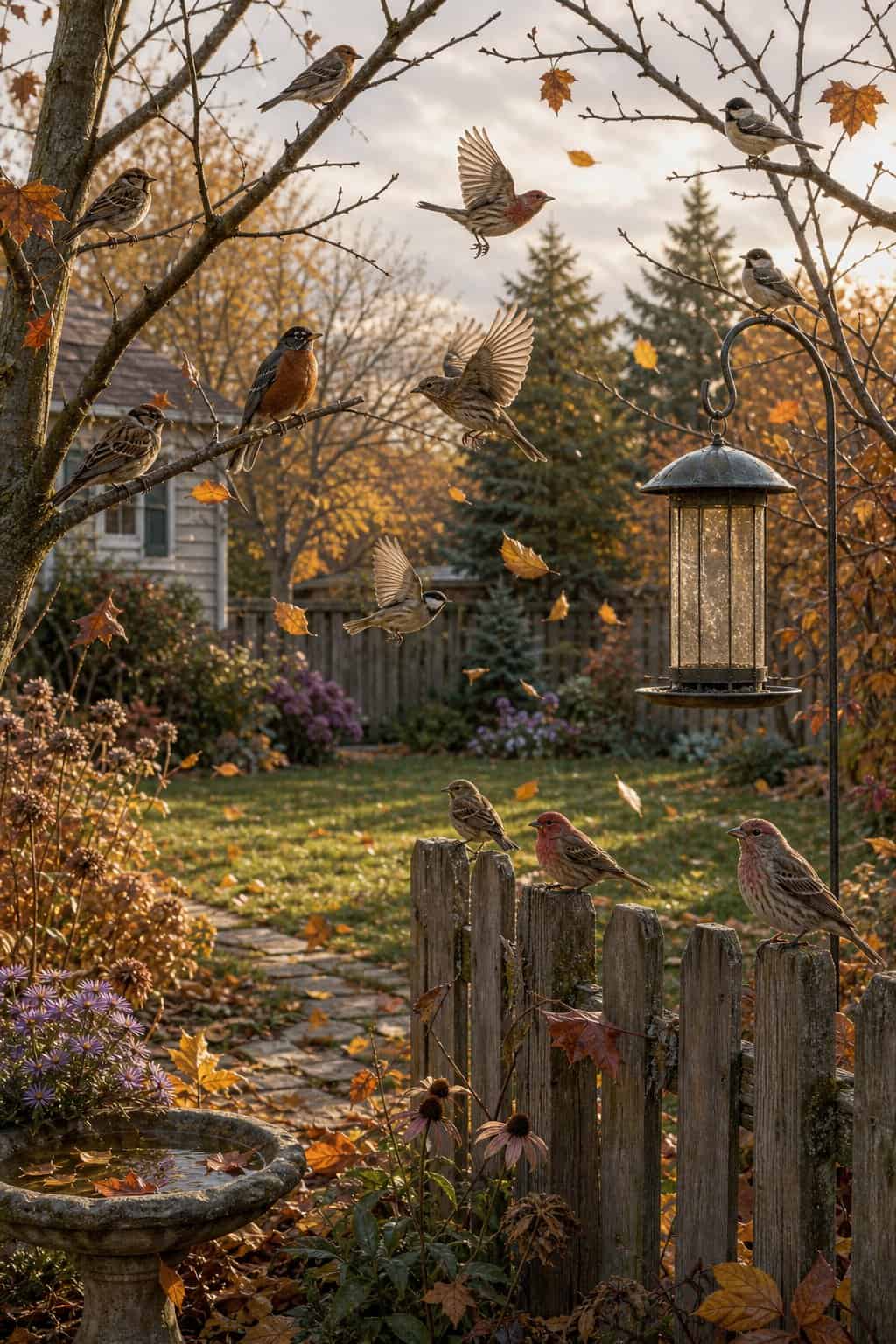
Silence in a yard does not mean the same thing in April as it does in August. The seasonal context changes which explanations are most likely and what behavioral evidence to look for.
Migration Periods and Shifts in Activity
Yards that suddenly go quiet on clear, mild mornings in spring or cool, overcast nights in fall are often losing birds to departure rather than to disturbance. Flocks that had been calling and feeding may lift off together and pass overhead, silencing the area for minutes to hours at a stretch. Physiological studies document the fattening, nocturnal fueling, and synchronized departure cues that drive these movements, including shortening nights and favorable tailwind conditions (Newton 2008).
There are specific patterns that are important to note. Warblers and thrushes usually migrate at night and silently rest in the vegetation. Jays and starlings migrate in daytime waves. With these birds, you might notice sudden decreases in feeder traffic, flocks perched in powerlines, and increased movement during first light. Providing high-energy food and water during migration windows helps staging birds efficiently prepare for departure.
How Breeding Cycles Reshape Daily Sound Patterns
Yard silence also comes when birds shift from territorial singing into incubation and then to nesting and chick rearing. Males sing early in the season to establish territories and to attract mates, and then sing less. Research on passerines shows that during incubation, vocal activity in the daytime drops and the parents become quiet and trade displays to avoid predation around the nest (Catchpole and Slater 2008).
By the end of May, the yard is less busy. The robins remain active at the feeders, but their calls are less frequent, and the sparrows become quiet. Avoiding heavy gardening and hedge trimming from late April to early July allows birds to have the cover they need to complete their nesting without abandoning their established sites.
The yard is silent. Something has caused it. Nine times out of ten, the clues sit right there in the stance, sky, or bush line waiting for the reader.
📷 Show us your feeder setup! Share a few photos of your feeders and you might be featured on Wild Bird Scoop. Share your setup →