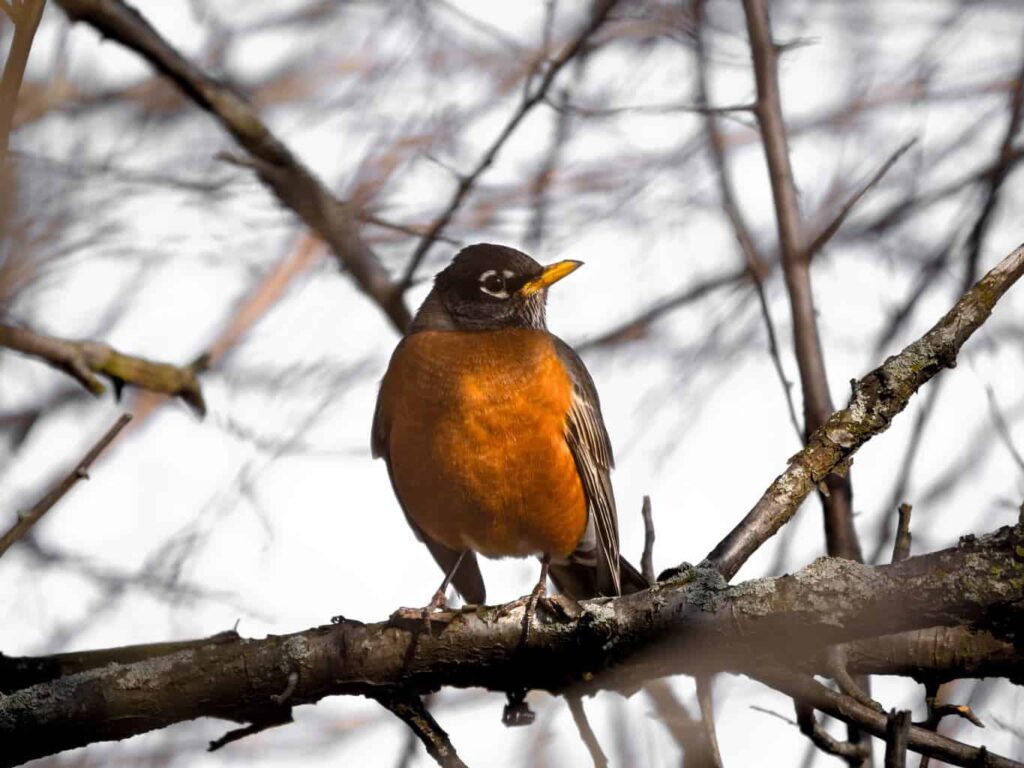
Robins seem like simple backyard birds, but these familiar creatures harbor some of the most surprising secrets in the avian world. What most people think they know about robins turns out to be surprisingly wrong, from their hunting methods to their actual species classification.
Bring Hummingbirds Right To Your Window!
Check PriceLook closely at a robin’s breast and you’ll notice something surprising. The color isn’t actually red at all—it’s distinctly orange.
Save this article for later so you don't lose it. Enter your email and I'll send it to you now—plus you'll get my favorite backyard birding tips delivered to your inbox.
This naming confusion traces back centuries to medieval England. When robins first received their common name, the English language lacked a proper word for orange.
The orange fruit arrived in England during the 1300s. However, the color term “orange” didn’t enter common usage until the 1500s.
Before this linguistic development, anything orange-colored was simply called red. People grouped these warm hues together under the broader “red” category.
Before “orange” existed as a color word, everything orange was simply called “red.” By the time the color term caught on, “robin redbreast” was already established.
By the time “orange” became an established color name, “robin redbreast” was already deeply embedded in English culture. The traditional name stuck despite its technical inaccuracy.
Key Facts About Robin Breast Color:
- Both male and female robins display orange breasts year-round
- Males show more vibrant coloration than females
- The orange becomes more noticeable against winter snow
- Carotenoid pigments from their diet create this distinctive coloration
They Can Hear Earthworms Moving Through Soil
American robins possess remarkable auditory abilities that allow them to detect earthworms moving beneath the ground. This behavior has fascinated naturalists since the 1800s, when observers first noticed robins cocking their heads and appearing to listen before striking the soil.
Scientific experiments have confirmed this ability. Canadian biologists conducted controlled studies with captive robins to test whether these birds truly rely on hearing for worm detection. The research eliminated other potential senses like smell and vibration detection.
Robins can detect the faint rustling sounds that earthworms make as they move through soil and leaf litter. These sounds are completely inaudible to human ears. The birds often stand motionless with their heads tilted, listening intently for these subtle audio cues.
Their hearing is so precise that robins can pinpoint the exact location of a worm underground. After detecting the sound, they strike with remarkable accuracy, often pulling up an earthworm on the first attempt.
Baby Robins Eat 14 Feet of Earthworms Over Two Weeks
Baby robins display an appetite that defies belief. According to Journey North, a single young robin consumes 14 feet of earthworms during its entire two-week nest life.
14 feet over 14 days = 1 foot per day, not 14 feet daily. Still impressive for a baby bird weighing less than an ounce!
This remarkable feeding pattern translates to roughly one foot of earthworms per day during their nestling period. The continuous demand for nutrition drives parent robins to make between 100-150 feeding trips daily during peak nestling periods.
Both mother and father robins share the exhausting duty of feeding their voracious offspring. Adult robins demonstrate exceptional hunting skills, capturing up to 20 earthworms per hour to meet their babies’ needs.
Key feeding facts:
- 14 feet of earthworms consumed in 14 days
- Parents make 100-150 daily feeding trips
- Adults hunt 20 worms per hour during peak times
They Sleep Standing Up on One Leg
Robins display a remarkable sleeping behavior that appears almost impossible to humans. These common backyard birds routinely sleep while perched upright on branches, often balancing on just one leg.
This standing sleep position serves multiple survival purposes. Birds can escape quickly from predators since they remain upright and ready for immediate flight. Their bodies stay prepared for instant takeoff without the delay of getting up from a lying position.
Robins use “unihemispheric slow-wave sleep” – one brain half stays alert for danger while the other rests.
Temperature regulation drives much of this behavior. When robins tuck one leg into their warm belly feathers, they reduce heat loss by half through their bare limbs. The exposed leg receives less blood flow, conserving body heat during cold nights.
Get our free Hummingbird Attraction Guide! Plus, we'll send you our best tips for attracting more birds to your yard.
Robins achieve this balance through a specialized locking mechanism in their leg tendons. When they perch, their tendons automatically grip the branch without conscious effort. This allows them to maintain their position even while fully asleep.
Robins Can Live Up To 13 Years (Most Don’t Make It Past 1)
The American Robin presents a striking contradiction in terms of longevity. While these birds can theoretically live over a decade, the harsh reality tells a different story.
Robins face a 50-50 chance of surviving their first year. Environmental stressors, predators, and harsh weather conditions create significant obstacles for young robins during this critical period.
– 50% survive first year
– Survivors typically live 2-6 years
– Record holder: 13 years, 11 months
Most robins that survive their challenging first year live approximately 2 to 6 years in the wild. This represents a dramatic improvement in survival odds once they develop essential life skills.
| Life Stage | Typical Lifespan |
|---|---|
| First year survival rate | 50% |
| Post-first year | 2-6 years |
| Maximum recorded | 13-14 years |
They Migrate At Night Using Star Navigation
Robins possess remarkable navigational abilities that allow them to travel hundreds of miles during nighttime migrations. These birds use a combination of celestial cues and Earth’s magnetic field to find their way across vast distances.
Stellar Navigation System
During night flights, robins rely on star patterns to maintain their direction. They can identify specific constellations and adjust their flight path based on the stars’ positions throughout the night.
Magnetic Field Detection
Robins have specialized cells containing magnetic crystals near their nostrils. These crystals help them detect Earth’s magnetic field lines, providing an internal compass system that works even on cloudy nights when stars aren’t visible.
– Star patterns for clear nights
– Magnetic crystals near nostrils for cloudy conditions
– Sun position for daytime travel
| Navigation Method | When Used | Accuracy Level |
|---|---|---|
| Star patterns | Clear nights | High |
| Magnetic field | All conditions | Moderate |
| Sun position | Daytime travel | High |
Male Robins Fight Their Own Reflection Until Exhaustion
Male robins cannot distinguish between their reflection and a real intruder. When they see themselves in windows, mirrors, or shiny car surfaces, their territorial instincts kick in immediately.
The biological response is automatic and relentless. Breeding season hormones drive males to defend their territory against any perceived threat. Their brains interpret the reflection as a rival male that must be eliminated.
– Messy marks on mirrors/windows
– Repeated loud tapping sounds
– Visible bird fatigue
– Damaged tail feathers
This behavior becomes particularly intense during spring months. Male robins will repeatedly attack the same reflective surface for hours or even days. The American Robin’s territorial nature makes them especially vulnerable to this exhausting cycle.
Common reflection sources that trigger attacks include:
- Car mirrors and windows
- House windows
- Shiny outdoor fixtures
- Pool surfaces
They’re Actually Thrushes, Not True Robins
The American robin carries one of nature’s most misleading names. Despite being called a “robin,” this familiar backyard bird belongs to the thrush family (Turdidae), not the true robin family.
Early European settlers in North America named these birds after the European robin due to their similar red breast coloring. However, the two species aren’t closely related at all.
– American Robin: Thrush family
– European Robin: Old World Flycatcher family
– Last common ancestor: ~17 million years ago
| Characteristic | American Robin | European Robin |
|---|---|---|
| Family | Thrush (Turdidae) | Old World Flycatcher |
| Size | 10 inches | 5.5 inches |
| Body shape | Upright, thrush-like | Compact, rounded |
American robins display classic thrush features that become obvious once you know what to look for. Their upright posture when walking across lawns is distinctly thrush-like. They hunt for ground insects and worms in the same methodical way as other thrush family members.
Young robins make the family connection even clearer. Baby American robins have spotted breasts, just like other thrushes. This spotting fades as they mature into adults.
Robins Can Have Up To 3 Broods In One Season (That’s 12+ Babies!)
American Robins are remarkably productive parents. These familiar birds can raise two to three broods during a single breeding season.
Each brood typically contains 3-5 bright blue eggs. The female incubates them for about 12-14 days before they hatch.
– 3 broods × 4 eggs average = 12 babies per season
– Maximum potential: 15 young birds
– Breeding season: April through July
Simple math shows the impressive results:
- 3 broods × 4 eggs per brood = 12 babies per season
- Some pairs with maximum broods can raise 15 young birds
The breeding season runs from April through July in most regions. Robins in warmer southern areas sometimes manage a fourth brood.
Female robins handle all nest building duties. They choose safe spots in trees, shrubs, or sometimes unusual places like outdoor light fixtures.
Both parents work together to feed and protect their growing chicks. The demanding job of raising multiple families requires enormous energy from the adult birds.
This multi-brood strategy helps robin populations stay strong. Even if predators or bad weather destroy one nest, parents can try again with another brood.
The rapid 14-day development time allows robins to squeeze multiple families into one short season. This efficiency makes them one of North America’s most successful bird species.
📷 Show us your feeder setup! Share a few photos of your feeders and you might be featured on Wild Bird Scoop. Share your setup →