
Every passage below is reprinted word for word from Charles Bendire’s Life Histories of North American Birds (1895), Edward Howe Forbush’s Birds of Massachusetts (1927), Alexander Wilson’s American Ornithology (1810s text, Jardine edition), and Elon Howard Eaton’s Birds of New York (1914), cited in full at the end.

The Camera Feeder We Use In Our Own Backyard
See Today's PriceThe best-known bird in America
Bendire, 1895: The American or Common Crow, one of the best-known birds of our avifauna, is widely but somewhat irregularly distributed over a large portion of the North American continent. While somewhat rare in the more northern parts of its range, and possibly entirely absent in certain sections, notably so throughout the greater portion of Labrador and the regions adjoining Hudson Bay, it is nevertheless found in other localities at much higher latitudes, and is known to breed even within the Arctic Circle.
Save this article for later so you don't lose it. Enter your email and I'll send it to you now—plus you'll get my favorite backyard birding tips delivered to your inbox.
Mr. R. MacFarlane obtained two sets of its eggs on the lower Anderson River, in about latitude 68° 35’ N. One set of five eggs was taken on May 5, 1866, and contained large embryos when found, an unusually early breeding record for that region.
Forbush, 1927: Unfortunately for the Crow he has a bad reputation, and it must be admitted that there is some reason for the low regard in which he is held among men. First he is black, the color of evil; then, he knows too much; his judgment of the range of a gun is too nearly correct.
If Crows could be shot oftener they would be more popular. Henry Ward Beecher once remarked that if men wore feathers and wings a very few of them would be clever enough to be Crows. Also, as Dr. N. A. Cobb says, “The Crow rises too early.” We have to get up very early in the morning to get ahead of the Crow.
Most of us rarely see the sun rise, and while the sluggards still slumber, the early Crow is up to some abominable mischief in the back yard. It irritates us to have this disreputable fowl take such a mean advantage of us, especially as we know that it would not have happened had we been up and about, as we know we should have been.
Then, according to human standards, the Crow is a thief and a robber. He steals eggs, chickens, corn; he robs song birds of their eggs and young, and so he is vilified and anathematized, pursued and destroyed, at every opportunity; but all to little purpose, for we may well believe that there are more Crows in the country now than there were when the Pilgrims landed on Plymouth Rock.
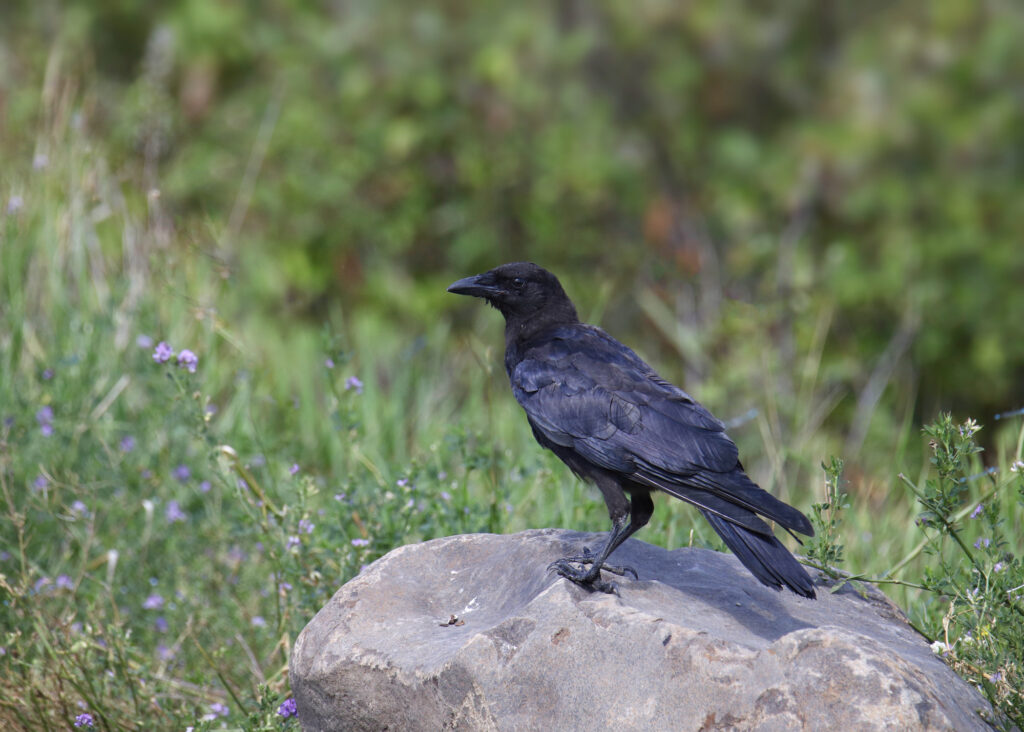
To-day then, the Crow is the great American bird. Everybody knows him. How many people have ever seen the American Eagle except on the silver dollar? But who has not seen the Crow? If a person knows only four birds, one of them will be the Crow. The bird is well known because he is large, black, ubiquitous and noisy.
He is well worth knowing. Each Crow is a character. There is more difference in Crows than appears as they fly over.
Wilson prosecutes — and defends — the crow, 1811
Wilson: This is perhaps the most generally known, and least beloved, of all our land birds; having neither melody of song, nor beauty of plumage, nor excellence of flesh, nor civility of manners to recommend him; on the contrary, he is branded as a thief and a plunderer — a kind of black-coated vagabond, who hovers over the fields of the industrious, fattening on their labors, and, by his voracity, often blasting their expectations.
Hated as he is by the farmer, watched and persecuted by almost every bearer of a gun, who all triumph in his destruction, had not Heaven bestowed on him intelligence and sagacity far beyond common, there is reason to believe that the whole tribe (in these parts at least) would long ago have ceased to exist.
It is in the month of May, and until the middle of June, that the Crow is most destructive to the corn-fields, digging up the newly planted grains of maize, pulling up by the roots those that have begun to vegetate, and thus frequently obliging the farmer to replant, or lose the benefit of the soil; and this sometimes twice, and even three times, occasioning a considerable additional expense, and inequality of harvest.
No mercy is now shown him. The myriads of worms, moles, mice, caterpillars, grubs, and beetles, which he has destroyed, are altogether overlooked on these occasions. Detected in robbing the hens’ nests, pulling up the corn, and killing the young chickens, he is considered as an outlaw, and sentenced to destruction. But the great difficulty is, how to put this sentence in execution.
In vain the gunner skulks along the hedges and fences; his faithful sentinels, planted on some commanding point, raise the alarm, and disappoint vengeance of its object. The coast again clear, he returns once more in silence, . to finish the repast he had begun. Sometimes he approaches the farm-house by stealth, in search of young Chickens, which he is in the habit of snatching off, when he can elude the vigilance of the mother hen, who often proves too formidable for him.
A few days ago, a Crow was observed eagerly attempting to seize some young Chickens in an orchard, near the room where I write; but these clustering close round the Hen, she resolutely defended them, drove the Crow into an apple-tree, whither she instantly pursued him with such spirit and intrepidity that he was glad to make a speedy retreat, and abandon his design.
This is perhaps the most generally known, and least beloved, of all our land birds; having neither melody of song, nor beauty of plumage, nor excellence of flesh, nor civility of manners to recommend him
Nest, eggs and the 292-egg museum series
Forbush’s breeding data: Breeding. — Usually, but not invariably, in woods. Nest: In deciduous or coniferous tree, rarely in bush where no trees grow; from 6 to 60 feet from ground; large, built of strong sticks and lined with shreds of grapevine or strips of cedar bark, bits of squash vine, fine roots, dry grass, seaweed, leaves, moss, straw, wool, hair, rags or some similar material, rough and straggly outwardly but well made and warmly lined.
Eggs: 3 to 8, very rarely 9, usually 3 to 5 (in cases where the larger numbers are found they are supposed to have been produced by two females); 1.42 to 2.06 by 1.02 to 1.40 in.; commonly ovate, but very variable in shape, pale bluish-green to olive-green or olive-buff, very rarely pink or even white; rarely unmarked, but usually with irregularly shaped blotches of various browns, and shades of gray variously distributed, sometimes covered with small spots; figured in Bendire’s “Life Histories of North American Birds,” Vol. II, Plate IV, Figs. 8 to 12 and Plate V, Figs. 21, 22.
Dates: Mid-March, South Carolina; March 27, District of Columbia; April 11, Pennsylvania; April 5 to June 13, Massachusetts; April 20 to May 25 (June 15), Maine. Incubation: Period variously given as from 15 to 18 days, probably by both sexes. One brood yearly; two are reared in South Carolina (A. T. Wayne).
Bendire on the nest: Nest building in the more southern States begins sometimes by February 20, and correspondingly later northward. In the vicinity of Washington, District of Columbia, fresh ees may be occasionally found in the last week in March, but more frequently during the first two weeks in April. Along our northern border they nest generally about the beginning of May; and even in the most northern portions of their range they have been known to breed equally early, but most frequently nidification here is protracted well into June.
In Idaho, Washington, and Oregon it is at its height between April 15 and May 20. ‘The nests are bulky, usually well constructed, and placed in the forks of branches, generally well up and hard to reach. Occasionally one is placed near the main trunk, this being mostly the case where bushy cedars or junipers are used.
Any sort of tree may be chosen for a nesting site, providing it is one of dense foliage, which will hide the nest well. In some localities pine trees seem to be preferred, while in others oaks are often selected. In the West cottonwoods, junipers, and willows are most frequently used. Nests are usually placed at heights varying from 20 to 60 feet; but I have found some barely 6 feet from the ground, and in many localities in the West they are rarely placed over 20 feet up, Here also they are said to occasionally nest on the ground, but I have never observed this personally.
Get our free Hummingbird Attraction Guide! Plus, we'll send you our best tips for attracting more birds to your yard.
Crows rarely nest in deep forests, the borders of woods and the river bottoms being preferred for such purposes. The nests are composed outwardly of sticks, weed stalks, corn husks, and other coarse material, and lined with grapevine bark, fine roots, dry grass, leaves, straw, moss, rags, wool, and hair, the lining varying in different localities.
Where cattle are plenty the nests are often found lined with more or less of their hair. These finer materials are well quilted together. The outer diameter of the nest is usually about 24 inches by 9 inches in depth. The inner cup is from 4 to 6 inches deep and from 12 to 15 inches in diameter.
This prevents the eggs from being thrown out of the nest during high winds when placed in slender branches in the extreme tops of trees.
The number of eggs to a set varies from four to eight. Sets of five are most commonly found, while those of seven are rare, and those of eight quite unusual. Mr. A. C. Kempton, Wolfville, Nova Scotia, writes me that he found a set of ten eggs in the spring of 1890, which he believes were laid by the same bird.
In the Western States usually from three to five eggs constitute a set, and those of six, according to my observations, are much rarer than in the East. Incubation lasts about eighteen days, and both parents assist in this duty. The young are born blind and naked, and remain in the nest about three weeks.
While Crows steal many of the eggs of other birds, they apparently do not molest any of their own kind, but if several pairs nest close together they will steal nesting material from each other whenever an opportunity occurs. ‘The old nests are resorted to for several seasons in succession where not molested. Only one brood is raised in a season; if the first eggs are taken, they usually lay a second set, but rarely in the same nest.
When the young are nearly fledged, they may often be seen sitting on the rim of the nest or on branches close by, watching for the return of the parents with food, and keeping up an incessant clamor.
And the eggs measured: The average measurement of two hundred and ninety-two eggs in the United States National Museum collection is 41.40 by 29.13 millimetres, or about 1.63 by 1.15 inches. The largest egg of the series measures 46.74 by 30.78 millimetres, or 1.84 by 1.21 inches; the smallest, 36.07 by 25.91 millimetres, or 1.42 by 1.02 inches.
| Measure | As the sources print it | Source |
|---|---|---|
| Eggs to a set | 3 to 8, very rarely 9, usually 3 to 5 | Forbush 1927 |
| Egg size, full range | 1.42 to 2.06 by 1.02 to 1.40 in. | Forbush 1927 |
| Average of 292 eggs, U.S. National Museum series | 1.63 by 1.15 inches | Bendire 1895 |
| Incubation | 15 to 18 days (Forbush) / about eighteen days, both parents assisting (Bendire) | both |
| Nest height | 6 to 60 feet from ground | Forbush 1927 |
| Massachusetts egg dates | April 5 to June 13 | Forbush 1927 |
| One New York winter roost | between 20,000 and 40,000 crows | Eaton 1914 |
The great winter roosts
A Bendire correspondent, from Iowa, winter of 1891-92: “In a woods near our home was a famous Crow’s roost. During the winter of 1891-92 the number was estimated at forty thousand birds. About sunset they came in small flocks and straggling companies from long distances away, gathering into great flocks on pastures and meadows, so thick as to look like plowed land.
In the dusk of evening the trees on a whole hillside appeared like a dark bank, so vast was the rookery. We visited this resort often after dark to hear the varied sounds that ever arose from the restless, scolding birds, whose voices were easily heard a mile distant. A whistle or shout was cause for alarm, and the entire flock would rise up like a dark cloud, and the beating of wings sounded like a strong wind.
Sometimes they would fly a mile off, and, returning, circle about and begin settling much as Chimney Swallows do, striking each other and the branches with their wings; the din of quarreling for places, changing, and flying up and down was terrible; some cawed loudly, others muffled the tones; some imitated the ery of a child, and some the squawk of a chicken; but the combined effect was a vast, weird wail that reverberated through the forest and died away on the night winds.”
Forbush on the New England roosts: In October before the frosts of autumn begin to form thin skims of ice around the shores of lakes in the northern woods, the Crows, which have been drifting down from the highlands into the valleys, form into great migrating flocks, not in any regular formation though occasionally columns or ring-shaped flocks are seen.
More often the birds fly southward in irregular masses, usually in daylight, as they rarely move about at night. These great flocks continue to pour southward in November, leaving behind in New England only a remnant of the vast summer Crow population. In southern New England, however, many Crows remain through mild winters wherever food is plentiful.
A piggery with its daily supply of garbage attracts a multitude. A corn-field from which not all the grain has been removed, the salt-marshes along the sea-coast, a crop of beechnuts or any large space of ground bare of snow will attract many winter Crows. At night these Crows assemble, sometimes from a distance of forty miles around, to a common roosting place.
In New England, white pine groves are favorites for Crow roosts. Farther south deciduous trees may be chosen. In one of the New England roosts as many as 50,000 to 100,000 (estimated) Crows have gathered at night. In the Middle States the numbers of birds assembled in a roost is much larger, and the estimates reach hundreds of thousands.
I have witnessed the assemblage of Crows in two large Crow roosts in Massachusetts, but those interested should read the account given by my friend, Samuel S. Rhoades, contributed to the American Naturalist in 1886, to get an adequate idea of the character of the great roosts of the Middle States and the numbers’ of their occupants.
In recent years many Crow roosts have been broken up by gunners and the 40U birds composing them have scattered to roost in smaller colonies from which persecution continually drives them; nevertheless some of the larger roosts still remain to be reckoned as among the most wonderful assemblies of birds to be seen now on the continent of North America.
Occasionally during severe winters considerable numbers of Crows are found dead in the woods. Sometimes they are the victims of a disease resembling roup, but possibly in some cases some are starved and frozen — victims of strong attachment for their winter home. In hard winters only a lone Crow or none at all will be seen in localities where hundreds appear in milder seasons.
Sometimes a single Crow in autumn, winter or early spring will join a flock of Starlings or grackles, flying and feeding amicably with them, as if desirous of their company or else finding safety in numbers. Crows swallow the hard parts of their food, and, after digestion has had its way, eject through the mouth such substances as hard seeds, fur, bones and teeth in the form of pellets, such as are regurgitated by birds of prey.
Eaton counts the New York roosts: The habits of the Crow are too well known to require extended comment, with the possible exception of its tendency to gather in roosts during the winter months. There are situated in New York State, on Staten Island, on Long Island, in the Hudson valley and in the lowlands of western New York perhaps one dozen to two dozen large crow roosts.
It has been practically impossible to obtain reliable information as to the different roosts. In the vicinity of the author’s home there has been for 15 years a large roost just west of the city of Rochester, usually in the town of Gates, and also an immense roost in the vicinity of Niagara Falls, a large roost in Ontario county, and another in Tompkins county near the head of Cayuga lake.
I have several times visited the Gates crow roost and as nearly as I could estimate the numbers congregated were between 20,000 and 40,000. During the day they are accustomed to spread over the country about the lower Genesee valley as far north as Scottsville and sometimes to Geneseo and along the shores of Lake Ontario and Irondequoit bay.
The Ontario crow roost was formerly just north of the village of Canandaigua. It has been moved several times within the last 12 years. Eleven years ago it was at Paddlefords Station in a small patch of second growth deciduous timber. The number of crows was estimated at 20,000 (see Eaton, Auk 20, 57-59).
The verdict — and the bounty that backfired
Forbush: Ornithologists do not agree regarding the economic status of the Crow. He has many partisans and many opponents. Numerous controversies have arisen over the bird, but the general concensus of opinion seems to be that the Crow is at least a necessary evil. Its habits of eating eggs and young of other birds should not count too heavily against it, as the birds thus molested usually have an opportunity to raise young later in the season, when the young Crows have been reared, and natural enemies of birds are necessary to keep their numbers within bounds.
Among the smaller birds such species as the Robin, Blue Jay and Bronzed Grackle suffer most. The reduction of the first brood of Robins may be a blessing to the grower of small fruits; Jays and grackles are themselves destroyers of the eggs and young of smaller birds and their numbers must be held in check. It should be borne in mind also that the Crow probably destroys the eggs of hawks and owls.
The following experience of the late Gardiner Hammond on Marthas Vineyard indicates that a successful attempt to exterminate the Crow might prove disastrous. Mr. Hammond owned great pastures where many sheep grazed. He told me once that he had offered a bounty of fifty cents each for Crows, as the birds had already killed about 200 of his newly born lambs, and that the native hunters under the stimulus of this bounty had killed nearly all the Crows about the Squibnocket region.
Notwithstanding my objection he continued to offer the bounty, although he expressed some fear that the expense would leave him bankrupt. About three years later he hailed me one day to see if I could determine what had destroyed the grass in his pastures. The grass was dead, having been cut off at the roots by white grubs which had increased so rapidly after the destruction of the Crows that they had already ruined a large part of the pastures. The offer of a bounty was withdrawn and the pastures gradually recovered.
Perhaps the greatest visible damage by Crows results from their habit of pulling sprouting corn, but that may be prevented by tarring the seed before planting; there are various devices that usually will keep them away from corn-fields, and poultry may be safeguarded from their attacks by wire netting. They are a serious menace however to a game farm or game preserve and their numbers about estates devoted to such purposes must be reduced.
We are not likely to exterminate the Crow, although by taking advantage of the bird’s weaknesses many may be killed, and sometimes such killings are justifiable. Thoreau says “this bird sees the white man come and the Indian withdraw, but it withdraws not. Its untamed voice is still heard above the tinkling of the forge. It sees a race pass away but it passes not away. It remains to remind us of aboriginal nature.”
Source
Charles Bendire, Life Histories of North American Birds, Vol. II, Smithsonian Institution Special Bulletin (1895) — Internet Archive “lifehistoriesofn00bend”. Edward Howe Forbush, Birds of Massachusetts and Other New England States, Vol. II (1927) — Internet Archive “birdsofmassachu02forb”. Alexander Wilson, American Ornithology (Jardine edition, 1832 printing) — Internet Archive “cu31924090265285”. Elon Howard Eaton, Birds of New York, Part 2, New York State Museum (1914) — Internet Archive “birdsofnewyork12eatorich”. Public domain. Internet Archive (BHL scans), four titles.
Passages reproduced verbatim from the scans listed; hard-wrapped lines rejoined (line-final hyphens closed up), the scans’ doubled word-spacing collapsed to single spaces, page headers, page numbers and footnote lines dropped. Accounts cut at paragraph boundaries; plumage, molt and range paragraphs and several anecdotes omitted whole. Eaton’s account prints as one continuous passage, so his roost passage is entered and ended at sentence boundaries (ending at the Auk citation). No text from Farmers’ Bulletin 630 appears anywhere in this article; the corn-stomach figures of that bulletin are deliberately absent, and Forbush’s paragraph citing them is omitted whole. OCR fixes applied (original → corrected): “fined with shreds” → “lined with shreds”; “or even white>” → “or even white;”; “(see Eaton, Auk 20, 57-59)-” → “(see Eaton, Auk 20, 57-59).”; “Tt isin the. month of May” → “It is in the month of May”; “Tus is perhaps the most generally known” → “This is perhaps the most generally known”; “approaches the farmhouse by stealth” → “approaches the farm-house by stealth”; “beetles, which+he has destroyed” → “beetles, which he has destroyed”; “branded as a thicf and a plundere —a” → “branded as a thief and a plunderer — a”; “he is* branded” → “he is branded”; “into an appletree, whither” → “into an apple-tree, whither”; “object.. The coast” → “object. The coast”; “pulling up the.corn” → “pulling up the corn”; “the ficlds of the industrious” → “the fields of the industrious”; “the room where 1 write” → “the room where I write”; “who all triumph. in his destruction” → “who all triumph in his destruction”; “would long ago have ceased to exist. .” → “would long ago have ceased to exist.”; “‘Sometimes he approaches” → “Sometimes he approaches”; “Inthe Western States” → “In the Western States”; “eges” → “eggs”; “egos” → “eggs”; “keepmg up” → “keeping up”; “large embroys” → “large embryos”; “‘In a woods near our home” → ““In a woods near our home”. No other changes.
📷 Show us your feeder setup! Share a few photos of your feeders and you might be featured on Wild Bird Scoop. Share your setup →