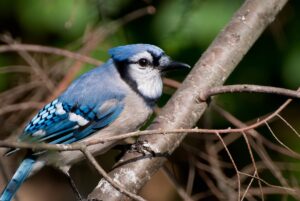
The passages below are reproduced verbatim from USDA Farmers’ Bulletin 630 (1926 revision) and Thomas Gentry’s 1882 Nests and Eggs of the Birds of the United States — the first supplying the stomach-by-stomach evidence, the second the character study.

The Camera Feeder We Use In Our Own Backyard
See Today's PriceThe accusation
The blue jay is a conspicuous member of our bird population east of the Plains, especially in autumn when his brilliant plumage contrasts vividly with the brown foliage. Even in winter he stays with us, though at this time he is less common along our northern border. In spring and summer, while by no means uncommon, the blue jay is not so often noticed, as the retiring disposition which he assumes during the breeding season assists in protecting him from enemies.
Save this article for later so you don't lose it. Enter your email and I'll send it to you now—plus you'll get my favorite backyard birding tips delivered to your inbox.
This also allows him to carry on with considerable impunity that inglorious practice of nest robbing of which, in a measure, he has been rightfully accused.
This also allows him to carry on with considerable impunity that inglorious practice of nest robbing of which, in a measure, he has been rightfully accused.

530 stomachs, 6 offenders
Examination of 530 stomachs collected at all times of the year in 30 of our Eastern States and Canada shows that insects comprise about 22 per cent of the yearly sustenance. About three-fourths of these are injurious, the remainder being neutral or beneficial. Of the injurious insects, grasshoppers form the largest portion; in August nearly a fifth of the food.
Caterpillars are conspicuous in July and August and at this time average about a tenth of the stomach contents. Both laboratory investigations and field observations have established the fact that in winter the eggs of the tent caterpillar and the hibernating larvæ of the brown-tail moth in New England are eagerly sought. Scarabæid beetles form about 4 per cent of the yearly food, and click beetles and wire-worms about 1 per cent.
Of the beneficial forms, ground beetles (3 per cent) and hymenopterous insects, part of which are parasitic (2.5 per cent), are taken most frequently. A few other invertebrates, as spiders, millipedes, mollusks, and crustaceans, also are eaten throughout the year.
In the consideration of the vertebrate food of the blue jay we are confronted with the problem of the destruction of wild birds and their eggs. Special search was made for every possible trace of such material in the stomachs, and in 6 of the 530 were found the remains of wild birds or their eggs.
In February two jays had killed a small bird apiece; in May one had robbed a nest of eggs; in June two had taken a small bird and a clutch of eggs, respectively; and in August another had robbed a nest. As this trait of the jay appears to be most pronounced during its own breeding season, it is quite possible for many birds which have suffered from its boldness early in the season to raise another brood unmolested.
Thirty-nine of the 530 jays examined had fed on hen’s eggs. Much of this food, however, was picked up about rubbish heaps, to which the jay, like other members of the crow family, is partial. While the result of stomach analysis would appear to belittle this fault of the blue jay, it is doubtless quite characteristic of the bird under favorable conditions.
Special search was made for every possible trace of such material in the stomachs, and in 6 of the 530 were found the remains of wild birds or their eggs.
Get our free Hummingbird Attraction Guide! Plus, we'll send you our best tips for attracting more birds to your yard.
Corn, acorns, and the verdict
Complaint that the jay is the source of considerable damage to corn in the fall has been verified to a certain degree by stomach examination. This grain is taken in every month of the year, but in greater quantities during winter and early spring, when much of it is necessarily waste, and it forms about 18 per cent of the yearly food.
Cultivated fruits of various kinds are eaten from June to the end of the year, and the 15 per cent taken in July apparently justifies complaints against the bird on this score. The favorite vegetable food of the blue jay is mast of various kinds, acorns predominating, but beechnuts, chestnuts, chinquaquins, and hazelnuts also are relished.
This food is important in every month but July and August, the yearly average being over 43 per cent, and from October to March it constitutes about two-thirds of the diet. Occasionally harm is done by feeding also on cultivated nuts, as pecans. Wild fruits are eaten during the summer and fall and constitute about 7 per cent of the yearly sustenance.
The blue jay probably renders its best services to man in destroying grasshoppers late in the season and in feeding on hibernating insects and their eggs, as it does in the case of the tent caterpillar and brown-tail moth. Such forest insects as buprestid beetles and weevils of various kinds also fall as its prey.
The blue jay’s vegetable food, with the exception of some cultivated fruit and corn in the fall, is largely neutral. The severest criticism against the species is the destruction of other birds and their eggs. Where we wish to attract birds in large numbers about our dooryards, in our parks, and in game preserves, it will be well not to allow the jays to become too abundant.
| Charge or food | What the 530 stomachs showed |
|---|---|
| Wild birds or their eggs | found in 6 of the 530 |
| Hen’s eggs | 39 of the 530 had fed on them, much of it picked up about rubbish heaps |
| Insects | about 22 per cent of the yearly sustenance; about three-fourths of them injurious |
| Grasshoppers | in August nearly a fifth of the food |
| Corn | about 18 per cent of the yearly food, much of it necessarily waste |
| Cultivated fruits | 15 per cent taken in July |
| Mast, acorns predominating | over 43 per cent for the year; about two-thirds of the diet from October to March |
| Wild fruits | about 7 per cent of the yearly sustenance |
Gentry’s character witness, 1882
On its temperament: Few species show more striking peculiarities of conduct, and none scarcely exhibit as much sagacity and intelligence. Within its natural haunts it is exceedingly shy and suspicious, and is hardly approachable. Frequent intercourse with man, however, has, in some sections, modified its disposition, and, as a necessary consequence, confidence has taken the place of distrust.
This is substantiated by its tendency to nest in places contiguous to the dwellings of man. In Eastern Pennsylvania, a decade ago, it was quite a common occurrence to find a score of birds nesting in a square mile of territory, but, at the present time, the collector considers himself very fortunate if he encounters one-fifth of this number within the same area, and these only in localities whose solitude is seldom unbroken by the tread of human footsteps.
In the wooded regions of Iowa, Mr. Allen found this species quite as trustful as the Black-capped Titmouse, and in Illinois, reduced to a semi-domesticated condition. Within the former State a pair of birds were found nidificating under the window of a house, in a lilac-bush, and this, too, in one of the most prominent and frequented streets of the town of Richmond.
A curious behavior marks the species’ first acquaintance with human society. The movements of man are followed with noteworthy pertinacity, the slightest action being carefully scanned, but our feathered friend never ventures too near at first. After frequent interviews at a wary distance, if undisturbed, he gradually approaches nearer and nearer, and in time comes to regard him with kindly favor.
Sometimes these advances are received with coldness, and the most bitter persecutions occur. When such is the case, the Jay takes a dislike to man, and shuns his society. In his rural retreats this bird is the enemy of the hunter, and often provokes his ire and vengeance by its tantalizing behavior. When he is in pursuit of game, it takes great delight in following him, and, by its seemingly distressing cries, seeks to warn its feathered neighbors of approaching danger.
On its nest: In the construction of a home both birds labor with the utmost diligence. They are usually about three days thus occupied, each bird taking an equal share in the task. The nest is anything but elaborate in its mechanism, and has little to recommend it in artistic design and beauty. It is a strong, coarse structure, placed upon a branch over a crotch, sometimes held in position by adjoining twigs, and is composed of sticks rudely and firmly interwoven.
Inside there is usually a lining of dark fibrous roots. In proportions it is almost equal to the nest of the Purple Grackle.
The domicile being completed, on the following day, sometimes not so soon, the female begins to lay, at the rate of one egg a day, her complement of eggs. This is usually five, although nests have been found with six, and others more rarely with four. Incubation is closely attendant upon oviposition, and generally dates from the day following the last deposit.
This business is the sole labor of the female for about seventeen days. While she is thus occupied the male encourages her by his presence, or when not foraging, guards the spot from intrusion. He is a very jealous husband, and will not permit any of the feathered denizens of the woods to approach, without resenting it in the most determined manner, and inflicting severe punishment. Human interference is greeted with loud and angry cries, and the infuriated bird is with difficulty beaten off.
Source
Some Common Birds Useful to the Farmer, USDA Farmers’ Bulletin 630, 1926 revision, ‘Blue Jay.’ Project Gutenberg #62678. Thomas G. Gentry, Nests and Eggs of the Birds of the United States (1882), Plate XLIII, Blue Jay. Project Gutenberg #45063. Public domain. Project Gutenberg #62678, #45063.
Passages reproduced verbatim. Mechanical edits only: footnote markers and figure references removed; illustration placeholders dropped; hard line-wraps joined; three 1926 OCR fixes: ‘the brown> foliage’ → ‘the brown foliage’ (stray character), ‘eagerly sought Scarabæid’ → ‘eagerly sought. Scarabæid’ (dropped period restored), ‘robbed a nest As this’ → ‘robbed a nest. As this’ (dropped period restored). Gentry’s account reflects the collecting practices of his era and is reproduced as a historical document. The table restates figures that appear in the reproduced text.
📷 Show us your feeder setup! Share a few photos of your feeders and you might be featured on Wild Bird Scoop. Share your setup →