

These 14 perennials are native to the Upper Midwest and Great Lakes region. “Native” is regional, so each entry lists where the plant grows wild. A few need moist soil or grow too tall for many strips, and those limits are noted.

The Camera Feeder We Use In Our Own Backyard
See Today's PriceCheck your city’s rules before planting; some limit plant height near corners and driveways. Water new plants deeply at planting and about an inch a week in dry spells through the first season.
Save this article for later so you don't lose it. Enter your email and I'll send it to you now—plus you'll get my favorite backyard birding tips delivered to your inbox.
1. Prairie dropseed (Sporobolus heterolepis)
Prairie dropseed is a fine-leaved bunchgrass native from Quebec to Saskatchewan and south in scattered spots to North Carolina, Texas and Colorado. It forms 2 to 3 foot mounds in zones 3–9, likes full sun and dry to average soil, and tolerates heavy clay. The late-summer flower sprays have a scent often compared to buttered popcorn.
It is slow to establish, so water new clumps weekly through the first summer if rain falls short. Once settled it is long-lived and drought tolerant. Its low height suits the edge of a strip where sight lines matter.
2. Wild geranium (Geranium maculatum)
Wild geranium grows wild from eastern Canada to Georgia and west to Manitoba, South Dakota and Kansas. It grows 1.5 to 2 feet tall in zones 3–8 and blooms pink to lavender in spring. The Xerces Society rates it as having special value to native bees and bumble bees.
This is a woodland plant. It wants part shade and moist, rich soil, so it fits a strip under street trees rather than a hot, open one. In full sun it needs steady water. It spreads slowly into patches, and deer usually leave it alone.
3. Foxglove beardtongue (Penstemon digitalis)
Foxglove beardtongue is native from Maine to Michigan and South Dakota, south to Virginia, Alabama and east Texas. It grows 3 to 5 feet tall in zones 3–8 and blooms white in late spring and early summer. It handles sun or part shade and dry to average soil, including clay, but not soggy ground.
The Xerces Society rates it as having special value to native bees and bumble bees, and hummingbirds visit the tubular flowers. Water new plants weekly in dry spells during the first season. The cultivar ‘Husker Red’ adds maroon foliage.
4. Black-eyed Susan (Rudbeckia hirta)
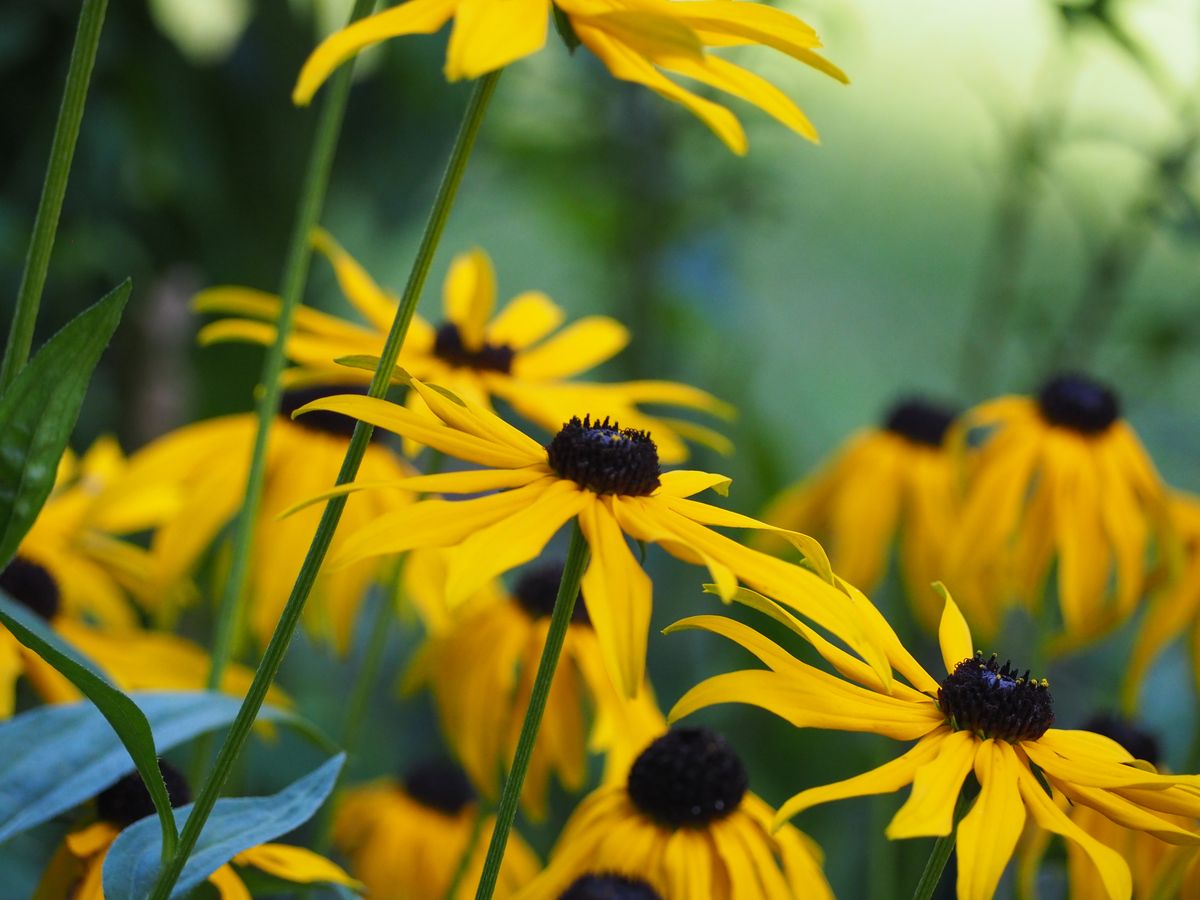
Black-eyed Susan is native from western Massachusetts to Manitoba and Wyoming, south to Florida and New Mexico. It grows 2 to 4 feet tall in zones 3–8. It takes full sun and dry to average soil and blooms from early summer into fall. Bees visit for nectar, and finches eat the seed.
It may act as an annual, biennial or short-lived perennial, but it reseeds to keep a patch going. Leave some seed heads standing in fall. That also means volunteers will show up in cracks and along the walk, so pull extras in spring.
5. Wild bergamot (Monarda fistulosa)
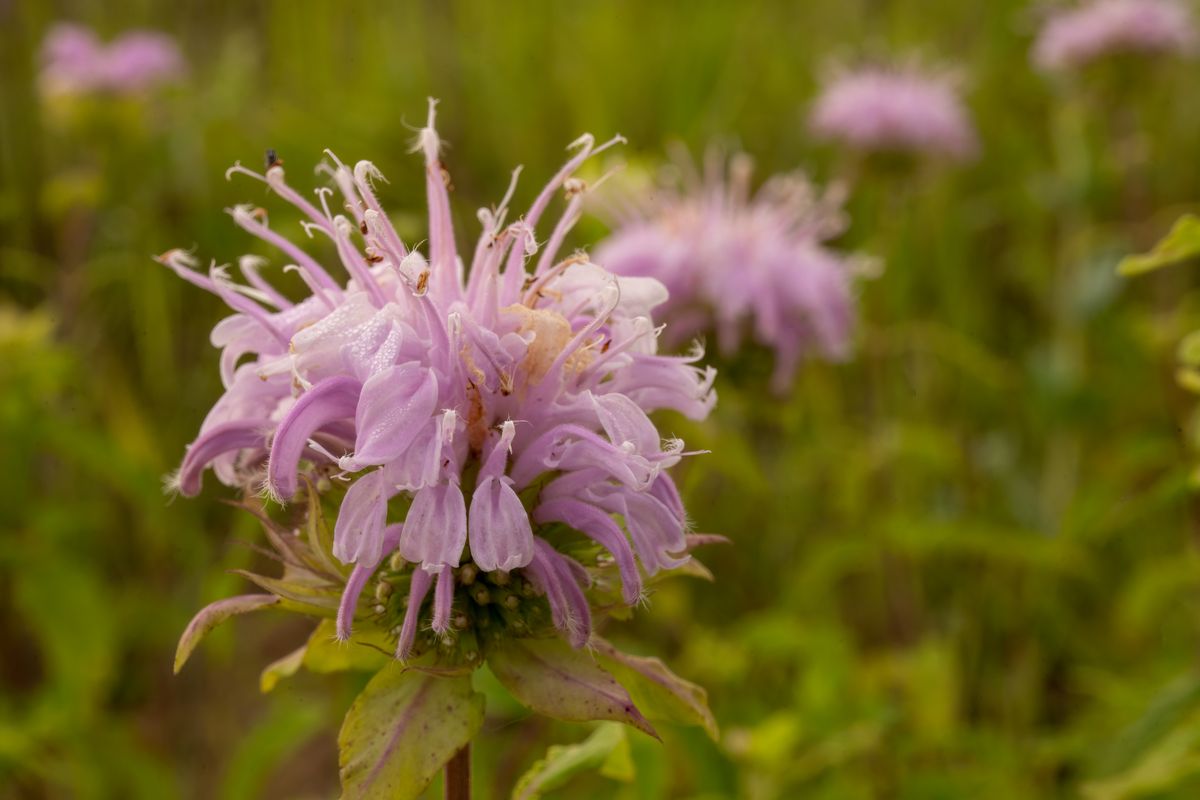
Wild bergamot is native through most of North America east of the Rockies. It grows 2 to 4 feet tall in zones 3–9, takes full sun to part shade and dry to average soil, and blooms lavender in midsummer. The Xerces Society rates it as having special value to native bees and bumble bees, and hummingbirds and butterflies visit.
It spreads by rhizomes, so expect it to fill a section of the strip. Powdery mildew is common late in the season, especially where air circulation is poor. Plant it behind shorter plants so the mildewed leaves are less visible.
Get our free Hummingbird Attraction Guide! Plus, we'll send you our best tips for attracting more birds to your yard.
6. Oxeye sunflower (Heliopsis helianthoides)
Oxeye sunflower is native from southern Quebec to Florida and west to British Columbia and New Mexico. It grows 3 to 6 feet tall in zones 3–9, takes full sun to part shade and dry to average soil, and blooms yellow from early summer into early fall. Bees and butterflies visit the flowers.
At that height it can block views and tends to flop, so taller plants may need staking. It can also get weedy by reseeding. In a strip, keep it away from corners and driveways and cut it back by a third in late spring to keep it shorter.
7. Purple coneflower (Echinacea purpurea)

Purple coneflower is widely planted, but its wild range is fairly narrow: Georgia to northeast Texas, north to Ohio, Illinois and Iowa. Farther north it is a garden plant rather than a local native. It grows 3 to 4 feet tall in zones 3–8, wants full sun and well-drained soil, and blooms through summer.
The Xerces Society rates it as having special value to native bees. Goldfinches eat the seed, so leave the heads standing into winter. Water new plants weekly the first summer. Once settled it handles dry spells well.
8. Anise hyssop (Agastache foeniculum)
Anise hyssop is native to the northern Great Plains and upper Midwest, from Colorado to Wisconsin and into Canada. It grows 3 to 5 feet tall in zones 4–8, needs full sun and well-drained soil, and blooms in July and August. The leaves smell like licorice.
The Xerces Society rates it as having special value to native bees and bumble bees. Plants are often short-lived but reseed freely, which fills gaps but also means pulling seedlings. Soggy winter soil is the most common reason it doesn’t return.
9. Great blue lobelia (Lobelia siphilitica)
Great blue lobelia is native from Connecticut to North Dakota and south to Georgia and Texas. It grows 1.5 to 4 feet tall in zones 4–9 and blooms blue from late summer into fall. The Xerces Society rates it as having special value to native bees and bumble bees.
It is not drought tolerant. Use it only in a low, damp section of the strip or near a downspout, and water it through dry spells. All parts are poisonous if eaten, so skip it where children or pets graze on plants near the sidewalk.
10. Yarrow (Achillea millefolium)
Yarrow grows across most of temperate North America, but the species also includes European strains that are sold widely. For a native planting, look for plants labeled as a North American variety or grown from local seed. It grows 1 to 3 feet tall in zones 3–9 and blooms white in summer.
It handles poor, dry soil and some salt, which suits a strip near a salted street. NC State Extension warns it spreads aggressively by rhizomes and seed, so deadhead it and plan to pull runners. It can irritate skin and is listed as a problem for cats.
11. Blue vervain (Verbena hastata)
Blue vervain is native from Nova Scotia to British Columbia and south to Florida and California. It grows 2 to 5 feet tall in zones 3–8 and blooms purple-blue from early summer into early fall. The Xerces Society rates it as having special value to native bees, and it hosts the common buckeye butterfly.
It needs moist to wet soil. In a dry, sunny strip it will struggle, so save it for low spots and water it through summer droughts. It reseeds, and it is fairly short-lived.
12. Culver’s root (Veronicastrum virginicum)
Culver’s root is native from Vermont and Ontario south to Georgia, Louisiana and Oklahoma. It grows 4 to 7 feet tall in zones 3–8 and sends up white spikes in midsummer. The Xerces Society rates it as having special value to native bees and honey bees.
That height makes it a poor fit for most sidewalk strips. Use it only in a wide strip away from corners, or move it to a bed along the house. It prefers moist, rich soil and is slow to establish, so water it weekly in dry spells for the first two summers.
13. Meadow blazing star (Liatris ligulistylis)
Meadow blazing star is native to the northern Plains and upper Midwest, from Colorado and the Dakotas to Minnesota, Wisconsin, Iowa and Illinois, and into the prairie provinces. It grows 1 to 3 feet tall in zones 3–8 and blooms purple from midsummer into fall. Unlike spike-type blazing stars, its round flower heads open at about the same time.
The Xerces Society rates it as having special value to native bees, and butterflies visit heavily. It prefers full sun and dry to average, well-drained soil, and wet winter soil can kill it. Water new plants weekly in dry spells through the first summer.
14. Showy goldenrod (Solidago speciosa)
Showy goldenrod is native from Massachusetts to the Georgia mountains and west to Wyoming and Texas. It grows 2 to 6 feet tall in zones 3–8 and blooms yellow in August and September. The Xerces Society rates it as having special value to native bees and honey bees.
For a shorter option, the ‘Golden Fleece’ cultivar of autumn goldenrod (Solidago sphacelata) is widely sold, but it spreads by rhizomes and seed. Goldenrod pollen is carried by insects, not wind, so ragweed is the usual allergy culprit.
📷 Show us your feeder setup! Share a few photos of your feeders and you might be featured on Wild Bird Scoop. Share your setup →





