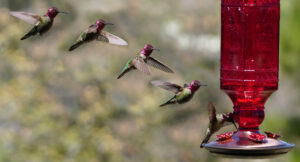
If you want to have a wildlife-friendly garden, one great thing to do is place hummingbird feeders.

The Camera Feeder We Use In Our Own Backyard
See Today's PriceHowever, hummingbirds are not the only ones attracted to the sweet nectar they contain. One issue often encountered by those trying to feed hummingbirds is ants on hummingbird feeders.
Save this article for later so you don't lose it. Enter your email and I'll send it to you now—plus you'll get my favorite backyard birding tips delivered to your inbox.
So, how to keep ants out of hummingbird feeders?

There are eco-friendly and sustainable solutions to keep these clever insects at bay that do not involve using harmful pesticides on your plot.
Do ants bother hummingbirds?
If you have ants on your hummingbird feeder, the first question that you might have is whether or not this is actually an issue.
Often, in an organic garden, we take a live-and-let-live approach. We often tolerate pest species in our space because they are not just pests but are crucial parts of the ecological systems around us.

Ants, per se, are not always an issue in gardens. However, when they get into inconvenient places or their populations surge to unmanageable numbers, then their colonies can, of course, become an issue. It can be a problem when they swarm onto bird feeders, supping on the sugar water you have made for hummingbirds.
If you only have a few ants, you might be confused about why this is an issue. But where there are a few ants, there can often soon be many, many more.
Some types of ants are actually a food source for birds who need insects as well as nectar as part of their diet. Many ants, however, are not appealing to hummingbirds – they don’t like the taste.
Ants are, unfortunately, a potential disease vector and can contaminate the food source of hummingbirds when they die in the sugar water. Hummingbirds seem to know this, and if ants take over a nectar feeder, hummingbirds tend to steer clear.
Will hummingbirds still feed if there are ants on the feeder?
If there are only a few ants, this will not always prevent hummingbirds from using a feeder. Typically, however, if the feeder is infested with ants, hummingbirds will no longer use your feeder and will find another food source.
If you have ever dealt with ants on your property before, you know that once ‘scout’ ants find a food source, they will go and tell all of their friends, and before you know it, the place turns into a buffet for ants.
So, you need to take steps to make sure that the feeder is clean and clear and stays that way to help your feathered friends.
How do I keep ants off my hummingbird feeder?

To keep ants off your hummingbird feeder, you need to place your feeder in the right spot. Also, keep it clean and free from leaks. You may then need to take steps to ensure that hummingbirds can access the sugar within while ants cannot.
Below, we’ll take a look at some simple and sustainable, eco-friendly strategies to try that should help you solve this problem.
Choose the Right Feeder Up Front
If you haven’t yet chosen a hummingbird feeder, and are worried about ants and other pests, the right feeder can make a big difference. After all, preventing an issue is always better than trying to solve it.
Get our free Hummingbird Attraction Guide! Plus, we'll send you our best tips for attracting more birds to your yard.

Kingsyard Glass Hummingbird Feeder, 24oz
Check PriceMany feeders can be purchased that already have built-in ant-moats and anti-bee measures affixed.
It is also a good idea to think about the material from which your entire feeder is made. Plastic feeders can be cheap and break easily. So think about choosing a more durable store-bought or DIY option.

Position the Feeder Correctly
If you want to make sure your feeder remains ant-free, consider where you place your feeder.
It is best to place a feeder in partial or light shade.

Avoid the center of your garden in full sun. Just make sure that you don’t place hummingbird feeders in too shady a spot.
Keep it Clean and Leak-Free
Ants are more likely to be enticed to hummingbird feeders leaking their sweet contents or if there are any spills. So another way to cut off this issue before it occurs is to keep your feeder in good order.

Exposure to the hot sun and the elements means that a cheap hummingbird feeder can easily become cracked or damaged.
So it is important to review the container regularly to stay on top of any potential issues and keep your hummingbird feeder clean.
Change Things Up
If ants have already discovered a hummingbird feeder, keeping them out might simply be a question of moving it to a new location within your garden.
If ants are a persistent problem, changing up the location of your feeder each year can mean that they are less likely to invade, while hummingbirds still have access when they arrive.

Hanging feeders from the wood structure of a porch or pergola, or support hanging from a rough wall, or a tree, may make them less accessible to ants.
Hang a Hummingbird Feeder With Fishing Line
If you use a thin and slippery fishing line to hang hummingbird feeders, ants will have to walk the tightrope to reach it.
This is one simple method you can use to deter ants by making it far more challenging to reach the ‘prize.’
Use an Ant Moat
The most effective method for most situations is to use a traditional ant moat to keep ants out of hummingbird feeders. An ant moat is a simple reservoir of water that ants cannot cross to reach the reward. An ant moat will be effective in most locations as long as you keep it filled with water.
If your feeder does not have an ant moat, you can easily make your own. This type of ant guard is a cheap and easy-to-install ant repellent.
Occasionally, ants may not be deterred. They may pile across the water and create a ‘bridge’ of ant bodies. And sometimes, in warmer climates, the water may evaporate too quickly and be challenging to maintain. But for most, this measure is enough (along with the above) to solve the issue.
Hang a Feeder Over Water
If you have particularly persistent ants where you live and ants moats have not worked well or been too difficult to maintain, another surefire method is to hang hummingbird feeders in the center of a large body of water. A wildlife pond, fountain, or other water feature can be an effective deterrent for ants.

The ants won’t cross that much water to scale the feeder pole and reach a feeder over fresh water, and the hummingbirds will like having the place to cool down and bathe close by.
Will Vaseline keep ants off the hummingbird feeder?
While all of the above methods are recommended in organic gardens, there are some ‘solutions’ that you should absolutely avoid.
Adding vaseline, Vix, vegetable oil, or any other greasy, sticky or slippery substance to hooks, chains or poles should definitely be avoided. While these options will deter ants, they can pose a serious threat to the hummingbirds themselves. If the birds get any of these substances on their feathers, it can impair their flight.
You should avoid adding anything but water to ant moats. Getting rid of hummingbird feeder ants may be essential – but should not be accomplished at the expense of the hummingbirds themselves, or other precious wildlife in your space.
To summarize:
| Strategy | Description |
|---|---|
| Choose the Right Feeder | Select feeders with built-in ant moats and anti-bee features; prefer durable materials. |
| Position the Feeder Correctly | Place feeder in partial or light shade; avoid full sun or overly shady spots. |
| Keep it Clean and Leak-Free | Regularly clean and inspect feeders for leaks or damage to prevent attracting ants. |
| Change Things Up | Move the feeder to a new location periodically to confuse ants and hang from less accessible spots. |
| Hang with Fishing Line | Use thin and slippery fishing line to make it difficult for ants to reach the feeder. |
| Use an Ant Moat | Install a water-filled ant moat on the feeder to prevent ants from reaching it. |
| Hang Over Water | Place the feeder over a large body of water like a pond or fountain to deter ants. |
| Avoid Harmful Substances | Do not use Vaseline, Vix, vegetable oil, or other greasy substances which can harm hummingbirds. |
8 Mistakes in Choosing Hummingbird Feeders (and How to Avoid Them)
If you’ve decided to upgrade your hummingbird feeder to one with an ant moat, here are some more tips and mistakes to avoid from our very own Ashe Samuels. You can read the full article here.
Key Takeaways
- The basics of choosing a hummingbird feeder involve the right color, strong materials, and a suitable hanger.
- More complex details include leakproof designs, ant moats, bee guards, and easily removable parts for cleaning.
- Personalizing your birding hobby is important, so consider the feeder’s style and features like a built-in camera.
Mistake 1: Thinking Any Bird Feeder Will Work for Hummingbirds
- Correct Approach: Use specialized hummingbird feeders that replicate their natural feeding environment.
- Tip: Choose feeders that are small, lightweight, and mimic the flowers hummingbirds sip from.

Mistake 2: Choosing a Model That Doesn’t Fit Your Outdoor Set-Up
- Correct Approach: Match the feeder to your available space using pole hangers or hooks, and avoid placing feeders too close to windows.
- Tip: Consider the location carefully, whether it’s a spacious backyard or a smaller patio, to ensure safety and accessibility.
Mistake 3: Picking the Wrong Color to Attract Hummingbirds
- Correct Approach: Choose feeders in red, orange, pink, or yellow to mimic flowers that attract hummingbirds.
- Tip: Avoid using food coloring in sugar water, as it can be harmful to birds.

Mistake 4: Using Only One Feeder to Attract Hummingbirds
- Correct Approach: Use multiple feeders to reduce territorial behavior among hummingbirds.
- Tip: Distribute several feeders around your yard to give hummingbirds plenty of space and reduce conflicts.
Mistake 5: Buying a Feeder That’s Too Difficult to Clean
- Correct Approach: Choose easy-to-clean feeders with removable parts.
- Tip: Look for feeders with detachable feeding ports, bee guards, and nectar bottles for easy disassembly and reassembly.
Mistake 6: Not Understanding the Benefits of Different Materials
- Correct Approach: Select feeders based on material properties:
- Plastic: Affordable but may warp in hot weather.
- Glass: Easy to clean but fragile.
- Metal: Durable but can rust.
- Tip: Consider the environmental conditions in your area and choose materials that will withstand those conditions.
Mistake 7: Not Choosing Hummingbird Feeders with Useful Add-Ons
- Correct Approach: Look for feeders with ant moats, bee guards, leak-proof designs, and bird cameras.
- Tip: These add-ons can significantly enhance your birding experience by keeping the feeder clean and functional.
Mistake 8: Choosing a Feeder That Doesn’t Fit Your Aesthetic
- Correct Approach: Ensure the feeder matches your outdoor furniture or personal taste.
- Tip: Choose a feeder that complements your garden’s aesthetic to make your bird-watching experience more enjoyable.
Conclusion
Avoiding mistakes with hummingbird feeders requires attention to detail but is highly rewarding. Key factors include feeder color, material, number of feeding ports, hanging style, and useful add-ons like ant moats or bee guards.
📷 Show us your feeder setup! Share a few photos of your feeders and you might be featured on Wild Bird Scoop. Share your setup →