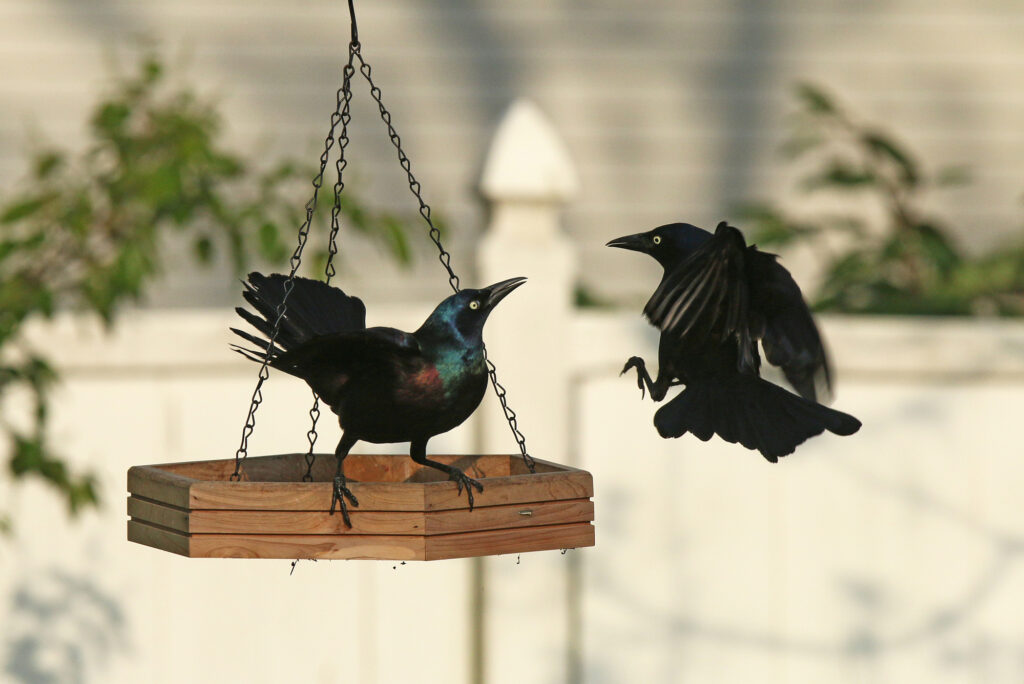

Not all bird feeder visitors are created equal. Some birds – even beautiful, colorful backyard visitors like the blue jay – can be considered backyard bullies because they can monopolize your feeders and keep other birds from visiting.

The Camera Feeder We Use In Our Own Backyard
See Today's PriceSome of them are big, while others punch above their weight class. Let’s learn about five (plus a few extras at the end) backyard bullies and some strategies you can take to help the underdogs overcome them for a seat at your bird feeder.
Save this article for later so you don't lose it. Enter your email and I'll send it to you now—plus you'll get my favorite backyard birding tips delivered to your inbox.
Key Takeaways & Quick Tips
- Feathered feuds: Just like our society, our backyards have their local ruffians. Meet the “backyard bullies” – a group of birds that include the large common grackle, the colorful blue jay, the intelligent European starling, the crafty house sparrow, and the freeloading brown-headed cowbird. These birds might seem straight out of a storybook, but their tendency to outmuscle the petite songbirds can turn our bird feeders into no-fly zones for the gentler folk.
- Diplomacy at the diner: As a steward of your backyard bistro, you’ve got a few tricks up your sleeve to ensure all birds get a fair shake at the seed spread, including:
- Exclusive entrance feeders: Set up feeders resembling members-only clubs with door policies: small entrances that keep the larger birds at bay.
- Diverse dining options: Scatter additional feeders around the yard to spread out the crowd.
- Selective menus: Serve up a special seed, such as Nyjer/thistle, a gourmet dish not everyone enjoys.
- Temporary time-outs: Sometimes, a brief hiatus of the feed service can persuade the bullies to move on, giving other birds a chance to perch in peace.
- Platform-free policy: Skip the large, open feeders which are like banquet halls for the larger birds, and opt for selective seed choices to discourage unwanted guests.
- Ethics and the law: When it comes to the feathered friends from across the pond, like the European starling and house sparrow, there are ethical considerations, even though they may not be native birds protected by federal law.
- Passive persuasion: We may deter nesting by playing interior decorator and controlling the nest box layouts.
- Active aversion: Sometimes, people may opt for getting hands-on, such as removing nests or setting up humane traps, but these tasks are often best left to the wildlife pros.
- Protecting the protected: With native notables like blue jays and brown-headed cowbirds, it’s important to use non-harmful ways to encourage them to feed elsewhere.
Common Grackle

Being one of the largest birds to frequent backyard bird feeders gives the common grackle an automatic advantage in the hierarchy.
But that size can also be used to your advantage when looking to deter these large, noisy blackbirds. Certain feeders with small openings are made to keep out squirrels, but they can also do the trick for grackles.

More Birds Double Cage Suet Feeder
Check PriceOne problem with these feeders is that they can exclude larger desirable birds like woodpeckers or cardinals. One thing you’ll want to avoid if you want to keep grackles off your feeders is a platform tray that gives large grackles ample room to make themselves at home. A smaller feeder with smaller footrests can keep these foot-long birds off.
Another solution – and possibly the easiest if you don’t mind feeding grackles but want the feeder available for other birds – is to toss some seed on the ground. Grackles are messy birds with a penchant for feeding from the ground, so you could solve your problem by spreading some seeds below your feeders and crossing your fingers that the grackles will leave the actual feeders to other birds.
As a final option, you could learn to appreciate grackles for their uniqueness. They may look to be plain black birds, but in the right lighting, iridescent feathers begin to reveal a blue head and bronzed back, especially on males.
Blue Jay
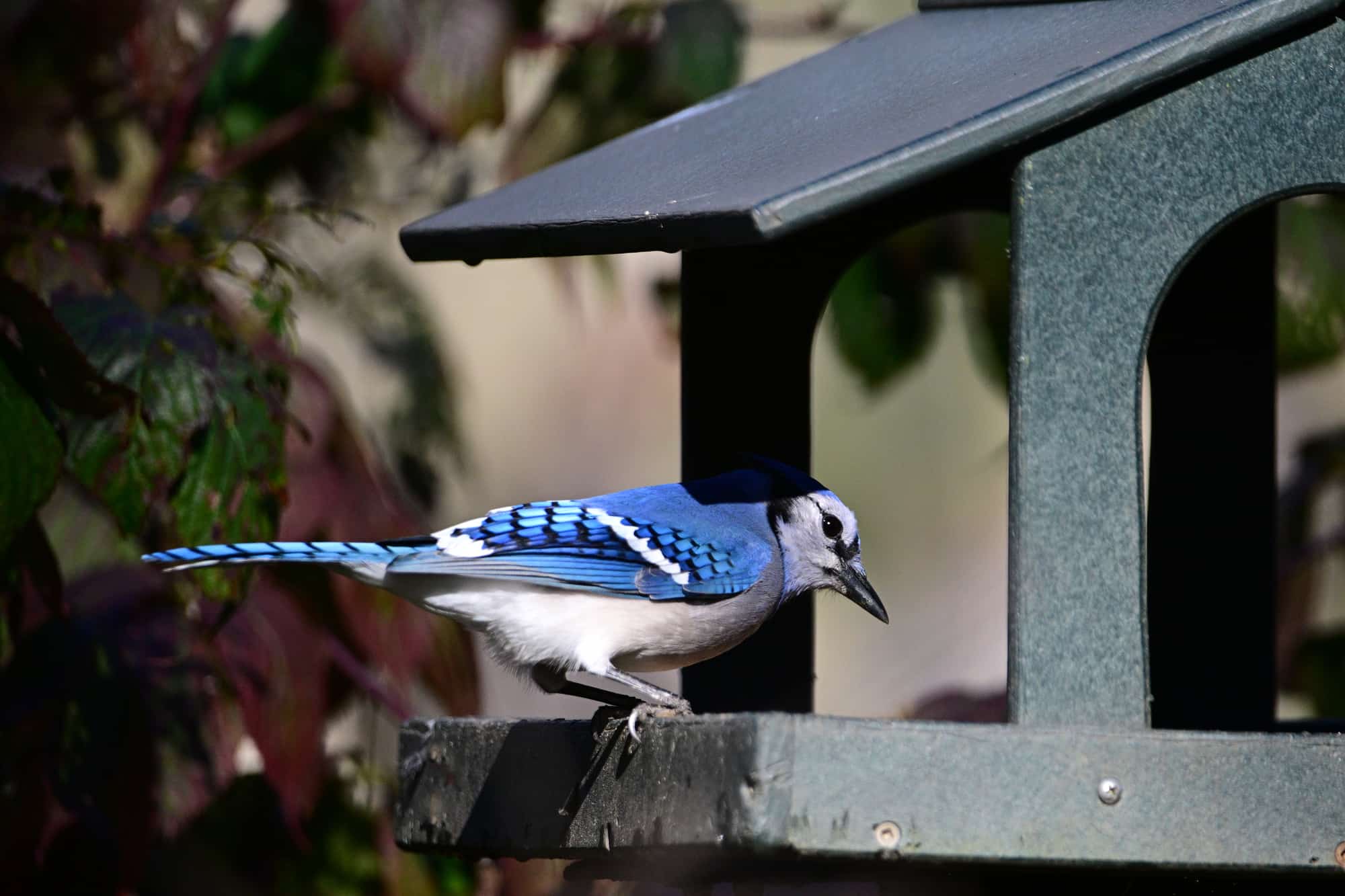
Blue jays can also be deterred by a smaller feeder with ports that exclude them, but many people don’t necessarily look to exclude blue jays like they do other bullies. Part of the reason for that is that they’re strikingly colored and native to North America, unlike other bullies such as the next two birds on our list.
But if you’re concerned that jays are taking over your feeder and keeping away other birds that you’d rather feed, there are a few steps you can take.
You can separate blue jays from other birds by setting up an additional feeder. A well-stocked feeder of in-shell peanuts can lead to a non-stop blue jay feeding frenzy, but be warned, once you’ve established that food option, the blue jays can tear through a bag of peanuts in no time.
A switch in your main feeder to Nyjer/thistle seed may also do the trick if you want to feed finches but your smaller backyard birds are being excluded by blue jays. The addition of a second feeder with similar seeds could allow smaller birds to feed while allowing blue jays to retain their main feeder stronghold.
European Starling

European starlings, known as the common starling in their native range, are beautiful birds, with speckled patterns and pointed yellow bills, but they’re notorious bird feeder bullies on a continent where they don’t belong.
One release of 100 birds in New York has led to the conquering of an entire continent from Hudson Bay down to the Gulf of Mexico, with over 200 million starlings in North America, according to All About Birds.
Starlings and other non-native birds like the house sparrow are not protected by the Migratory Bird Act, but lethal removal of these birds is typically not realistic, nor will it probably make a difference in terms of wider or even local populations.
They’re one of the more difficult birds to discourage. Many people will suggest simply removing feeders for a while in hopes that starlings will move on.
Switching food or which native species you’re targeting may also help. For example, switching to Nyjer/thistle seed in the hopes of attracting finches probably won’t appeal to starlings.
All About Birds also suggests that in-shell peanuts or white-striped sunflower seeds might be difficult for the soft, thin bills of the starling to handle.
Blue jays in particular are known to love in-shell peanuts, so that switch won’t deter them, but at least they’re native bullies, so they don’t usually elicit as much displeasure.
Get our free Hummingbird Attraction Guide! Plus, we'll send you our best tips for attracting more birds to your yard.
House Sparrow

House sparrows aren’t nearly as big as the other bullies discussed so far, but North American birders’ dislike for them is perhaps matched only by the European starling, given their non-native status.
House sparrows, a little bit chunkier than the average North American sparrow, are known for out-competing smaller native birds for food resources as well as nesting places. They’re cavity nesters, so bluebirds and tree swallows are among those that they can displace.
The biggest thing you can do to keep house sparrows away from your feeders is to discourage nesting if you have a small enough property where you know all the available nesting spots. On a large property with lots of trees, this may not be possible.
Whether you should remove or destroy nests is an ethical question that we don’t have the right answer for, necessarily.
House sparrows are not protected under the Migratory Bird Act, as a non-native species, but make sure to check local or state laws before taking action. The North American Bluebird Society, which states that “it is better to have no nestbox than have one that fledges house sparrows,” suggests actions, both passive and active, to control house sparrow nesting in places where bluebirds might nest.
Active control means monitoring nest boxes to remove house sparrow nests, and if the house sparrows won’t give up the nesting spot, trapping and removing them. This probably isn’t realistic or pleasant for the average person and makes more sense for a wildlife professional managing a property with numerous bluebird houses.
Passive control is a little more realistic for the average person. It could involve plugging nesting holes of boxes before house sparrows have a chance to lay eggs so they move on to another location, or placing boxes away from any farms, barns, or buildings.
For more from the Bluebird Society, click here.
If you’re simply trying to handle the swarm of house sparrows at your feeders, not manage their nesting habits, consider taking down your feeders once they’ve been taken over by house sparrows. Once the sparrows move on, you can reintroduce them and hopefully, the native birds will return.
House sparrows are also not huge fans of suet that doesn’t include seeds mixed in, nor do they typically eat Nyjer/thistle seed. A switch to these foods could be enough to see house sparrows move on, and then you can reintroduce regular seeds like sunflower or safflower.
One food you’ll want to avoid at all costs is millet. This seed is not generally preferred by many desirable backyard species besides ground-feeding birds like juncos or doves, but house sparrows do like it, so if you can avoid mixes that include it, that’s a plus.
Brown-Headed Cowbird

Another notorious nesting bully is the brown-headed cowbird for one unique behavior. Brown-headed cowbirds are nest parasites, meaning they lay their eggs in the nests of other birds and rely on other bird species to raise their young.
It seems unfair, but it’s part of nature, and brown-headed cowbirds are native birds, so it’s illegal to remove their eggs from nests, even if they’re not in the ‘correct’ nest.
So while you can’t really discourage brown-headed cowbirds from nesting as you can with house sparrows, you can do your best to not feed them.
Like grackles, brown-headed cowbirds like larger platform feeders and feeding on the ground. They’re not nearly as big as grackles, but they’re still generally bigger than the backyard birds most people prefer feeding.
Cowbirds aren’t known as big fans of suet, so introducing suet for nuthatches, chickadees, and woodpeckers can be a popular option, just make sure it doesn’t have seeds in it if you’re hoping not to become a haven for house sparrows.
Switching from sunflower seeds to safflower seeds can also be an option for dissuading some of these birds from visiting your feeder. Fewer birds prefer safflower seeds to tasty sunflower morsels, but northern cardinals and grosbeaks are among those that won’t mind the change.
Other Bullies: House Wrens, Red-Winged Blackbirds, and of Course, Squirrels

These five bullies are common in much of North America, but they’re not the continent’s only backyard bullies.
While the brown-headed cowbird lays its eggs in another bird’s nest, for example, the house wren is known to destroy other birds’ eggs, usually by poking holes in them. This helps the house wren remove competition and stake out territory in some of the hottest ornithological real estate out there: tree cavities and nest boxes.
Red-winged blackbirds, while popular with many birders, can also overtake a feeder and are even known to fend off huge birds or humans getting too close to their nests.
And how could we forget about backyard nemesis number one?
Squirrels, especially large gray squirrels, can take over a feeder and hang out all day if you let them.
Changing to safflower seeds, noise-makers or two-way audio feeders, squirrel-proof feeders, and squirrel baffles are all among the ways that birders have been trying to keep away squirrels since backyard birding began.
And sometimes, you just have to give up.
In Conclusion
When you’ve tried it all and nothing is working, you may just choose to embrace the birds (or rodents) in your backyard. It’s easier to wrap your head around with native birds or wildlife than it is with starlings or house sparrows, but there are interesting qualities for every species.
For example, even house sparrows live in an interesting military-esque social hierarchy based on the size of males’ black facial patches and starlings are intelligent mimics that can copy even human noises. If you take a little while to research these birds’ behaviors, you may begin to find them somewhat interesting.
Happy birding!
📷 Show us your feeder setup! Share a few photos of your feeders and you might be featured on Wild Bird Scoop. Share your setup →