


Spring migration brings different birds to different regions. Use the species below as a starting point, then compare them with local sightings. Arrival and departure dates vary; a calendar holiday does not create the same birdwatching window everywhere.

The Camera Feeder We Use In Our Own Backyard
See Today's Price1) Barn Swallow (Hirundo rustica)

On a warm morning, few birds command open farmland the way a Barn Swallow does. Dark blue backs flash as they quarter low over alfalfa fields, the deeply forked tail trailing behind each quick turn. They arrive in spring to breed, then head south before July in many regions, following insect peaks that shift earlier as temperatures climb. Studies show many leave by late June, well ahead of what most casual observers expect.
Save this article for later so you don't lose it. Enter your email and I'll send it to you now—plus you'll get my favorite backyard birding tips delivered to your inbox.
Casual birders can confirm the ID on the wing: long forked tail, white underparts, and a rusty-orange throat. The flight is fast and buoyant with sudden directional changes. A dry, twittering call carries well across open fields. Banding data indicate first broods often fledge by early June, and that fledging event triggers post-breeding movement almost immediately, which is why Barn Swallows are abundant now but noticeably scarce by mid-summer across much of their range.
2) Tree Swallow (Tachycineta bicolor)

At dawn over marsh pools, Tree Swallows catch insects in quick, tilting bursts, banking low with that distinctive white-belly flash. These birds are staging through the region now on their way to northern breeding grounds. By July, most have moved farther north or settled at higher latitudes.
Look for glossy blue-green backs and pure white underparts, with a slightly forked tail. They perch readily on fence posts and nest boxes, and the white rump is a reliable field cue during flight. Migration counts place peak passage in late April through May, with local nesting records dropping off sharply by June. That pattern is consistent with banding studies tracking swift northward movement toward breeding territory.
3) Common Nighthawk (Chordeiles minor)

The sky just after sunset is where this species makes its presence known. Thin, erratic silhouettes and a sharp, nasal “peent” call mark the Nighthawk’s insect hunts over parking lots and open fields. They migrate north in late spring to breed, then begin moving south before July to reach wintering areas in South America ahead of molt.
Long, sickle-shaped wings with a bold white bar near the wingtip, combined with buoyant, irregular flight at dusk, make them unmistakable once seen a few times. They roost on flat rooftops, gravel bars, and fence posts during the day, relying on cryptic plumage to stay invisible. Banding studies show many adults begin southbound movement in early June, which aligns with regional migration counts where peak passage shifts earlier in warmer years.
4) Bobolink (Dolichonyx oryzivorus)
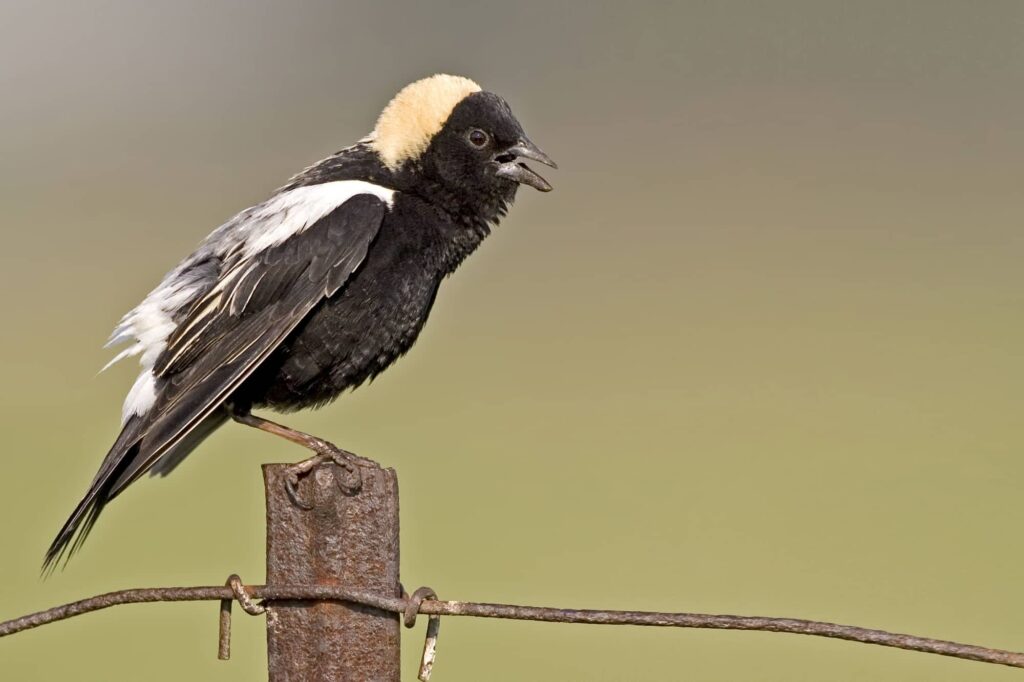
Few grassland birds produce a song as disorienting and memorable as the Bobolink’s. Males sing low over hayfields on warm spring evenings, a bubbling cascade of electronic-sounding notes that rises and falls as they circle. They arrive to breed in grasslands and leave early because their migration route to South America is one of the longest of any North American songbird. By July, many males have finished nesting and begun the southbound molt migration.
Spotting a male is straightforward: black below, white rump, golden nape, and that unmistakable song from low perches. Females are streaked and much duller, so concentrate on the black-and-white contrast to confirm a singing male. Long-term banding and radar studies indicate that Bobolinks reach peak abundance on breeding grounds in May through early June, with sharp declines by late June.
Bobolinks travel roughly 12,500 miles round-trip between North American grasslands and South American wintering grounds in the Pampas region of Argentina and Bolivia. That ranks among the longest migrations of any New World songbird, and it explains why departure timing is so compressed and predictable each year.
5) Baltimore Oriole (Icterus galbula)
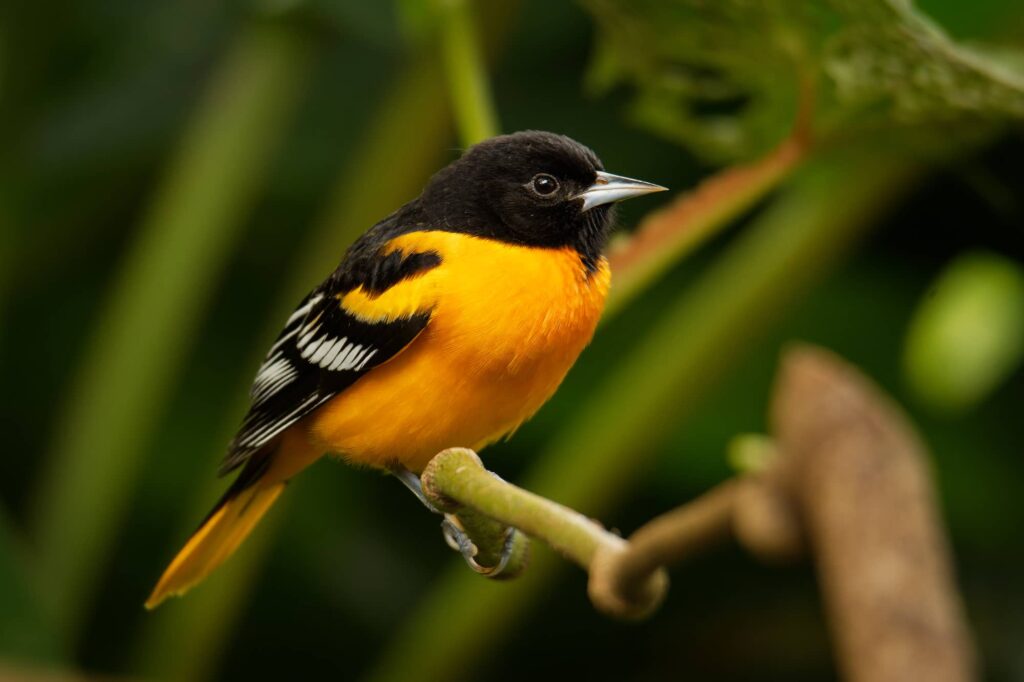
A male Baltimore Oriole sipping nectar at a feeder or working through a flowering crabapple is hard to miss. The flame-orange body, black hood, and white wingbars make it one of the most reliably identifiable birds in spring. They arrive in late April to breed, then start moving; by July, many have left to molt on northern breeding grounds or begin fall staging farther west.
The clear, fluting song carries well through open woodland, and the hanging cup nest woven into the end of a maple or elm branch is a classic piece of backyard architecture. Banding and migration studies document a consistent pattern: eastern orioles shift range after breeding, and local counts fall noticeably by mid-June as that movement begins.
6) Rose-breasted Grosbeak (Pheucticus ludovicianus)

On an early May morning, male Rose-breasted Grosbeaks sing from treetop perches with a rich, robin-like quality that rewards anyone patient enough to track it. White-wing patches flash as they stake out breeding territory after returning from wintering grounds in Central and northern South America.
Field identification is reliable: males carry a bold black-and-white pattern with a triangular rose-red chest patch that catches light at any angle. Females are streaked brown with buffy underparts and are often overlooked. The sharp, hollow call note helps separate both sexes from lookalikes at feeders. Banding studies show some adults depart breeding areas by midsummer if food or nest success is low, and younger birds often disperse earlier still. That compressed exit timeline is why sightings are common now and rare in July.
7) Gray-cheeked Thrush (Catharus minimus)
A single Gray-cheeked Thrush slipping through willow thickets at dawn is easy to overlook. It stops often to flip leaves and probe soft ground, feeding on insects and late berries before pressing north to tundra breeding grounds. The behavior is unhurried but purposeful, and the bird rarely lingers.
This species now appears because migration timing tracks insect emergence and the lengthening of days. By July, most are on Arctic nesting territories raising young. Geolocator studies show that some populations fly nonstop over the North Atlantic or take long coastal routes, meaning each stopover here is brief but essential for refueling.
Look for a plain brown back, faint pale eye ring, and a thin, almost flute-like song built from short rising phrases. The Gray-cheeked Thrush’s song is subtler than the Veery’s and lacks the bold eye ring of the Swainson’s. A nervous tail-flick from a low perch is a useful behavioral cue. Average nonstop flight distances for some populations exceed several hundred miles, which explains why these birds move through spring sites quickly and without much fanfare.
“Each stopover is a fuel stop, not a destination. The bird’s entire physiology is oriented toward departure.”
8) Western Sandpiper (Calidris mauri)

Small flocks probe mudflats with quick, pecking runs, feeding hard before pushing farther north. Western Sandpipers are on spring stopover now, refueling after leaving Pacific wintering grounds and heading toward Arctic breeding sites. Most will be gone by July.
Get our free Hummingbird Attraction Guide! Plus, we'll send you our best tips for attracting more birds to your yard.
Look for a fine, slightly drooping bill and rapid feeding movements. The faint buffy face and streaked back in spring plumage help separate it from similar peep species. They forage in tight groups that bob and jab in near-unison, a behavioral pattern worth noting as a field cue. Banding and radar studies indicate peak coastal stopovers in April through May, with sharp declines in counts by June.
9) Semipalmated Sandpiper (Calidris pusilla)
Tight flocks skimming mudflats with heads down and bills working are a familiar spring shorebird scene. Semipalmated Sandpipers are migrating north to Arctic breeding grounds, and by July most have already reached tundra nesting areas and begun incubating eggs.
The short, straight bill and faint webbing between the toes give this species its name. In flight, dark wingtips and a compact, rounded body help distinguish it from larger peep species. A long-term banding study documents many individuals flying nonstop from South America to the North American coast before continuing northward, which helps explain why spring stopovers on tidal flats are concentrated and time-limited. Shorebird counts spike in late May and drop sharply by mid-June, consistent with that movement pattern.
10) Willow Flycatcher (Empidonax traillii)

Along a wet willow-lined stream, the sharp “fitz-bew” call often arrives before the bird is visible. Willow Flycatchers pass through now to breed in dense willows and shrubby wetlands; most leave by July after nestlings fledge and parents shift into quieter post-breeding movements.
This is a chunky, short-billed flycatcher that flicks its wings and returns to a low perch to sally for insects. Within the notoriously difficult Empidonax genus, the two-part buzzy “fitz-bew” is the most reliable separator in the field. Banding studies show many eastern Willow Flycatchers complete nesting by late June, which accounts for the drop in sightings through July. Their timing links closely to peak insect abundance and the brief northern summer that supports only one brood per year.
With Empidonax flycatchers, skip the visual and go straight to sound. The “fitz-bew” of the Willow Flycatcher is one of the clearest two-part songs in the genus. If you are not hearing it, you cannot confidently confirm the ID in the field.
11) American Golden-Plover (Pluvialis dominica)
A lone plover dropping into a freshly plowed field and pacing deliberately is worth a second look. Spring migration funnels American Golden-Plovers across inland fields on their way to Arctic tundra breeding grounds, and by July, most have arrived well north of here.
The shape is compact with a short bill, and the steady rolling flight is punctuated by rapid wingbeats. Spring males show mottled black on the belly during courtship; worn plumage can look grayer and less sharply patterned. Banding and tracking studies show many individuals cross the continent in a few stops, and numbers at spring watch sites often fall sharply by late May. Open fields and freshly tilled ground are the habitat to check, and timing is everything with this species.
12) Swainson’s Thrush (Catharus ustulatus)
The upward-spiraling song rising from a dense forest edge at dusk is one of the more reliable signs that Swainson’s Thrush migration is underway. These birds pass through in spring on their way to boreal and montane breeding grounds, and most are gone by July when nesting is already well underway to the north.
The bold buffy eye ring is the quickest field mark, paired with a plain brown back and spotted breast. Compared to the Gray-cheeked Thrush, the eye ring is fuller and more obvious. The song, a series of thin, flute-like phrases that spiral upward, carries well through dense understory where the bird itself is rarely visible. Banding studies show many individuals travel in early morning and late evening, which explains why backyard sightings tend to cluster during cool hours at either end of the day.
13) Sandhill Crane (Antigone canadensis)
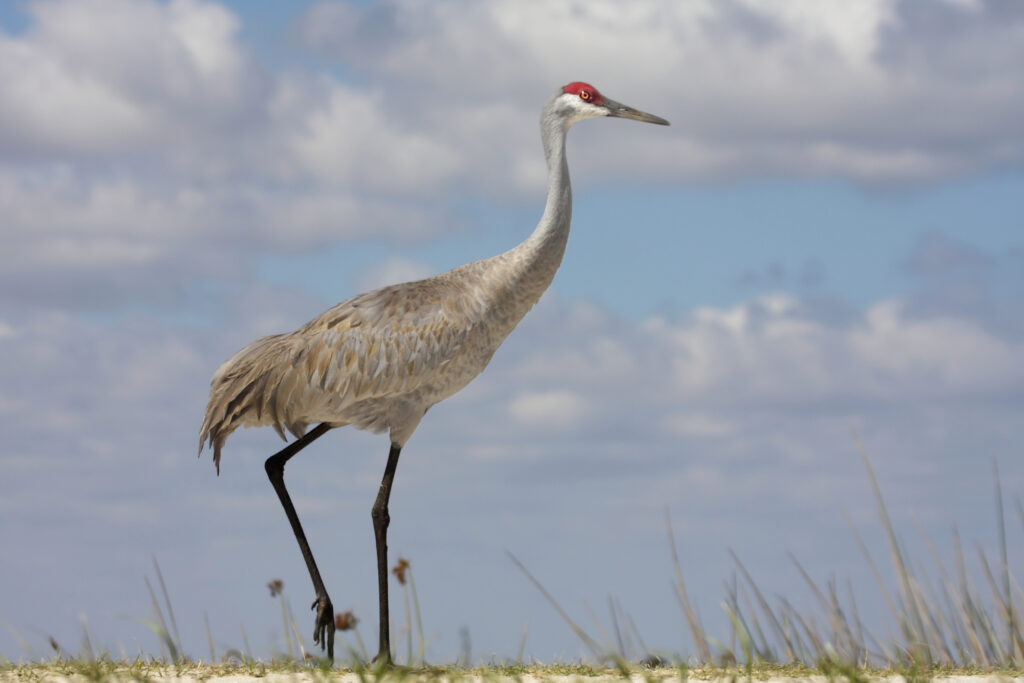
A pair striding through shallow marsh grass, necks extended, calling a deep rolling “kar-r-r” that carries for a mile, is not easily forgotten. Sandhill Cranes stop now to refuel on their way to northern breeding grounds. By July, most have reached tundra or boreal wetlands and are well into the nesting season.
Big gray bodies, pale cheeks, and a slow, deliberate wingbeat distinguish them from herons at a distance. They feed in fields at dawn and dusk, probing mud for tubers and roots. Migration studies show many eastern birds pass through staging areas in April through May and depart by late June. Regional counts confirm the pattern: high numbers in spring, near-zero by mid-summer.
Seasonal Triggers Behind the Timing
Birds do not migrate on instinct alone. They time their movements to specific environmental cues that align arrival with food availability and reproductive opportunity. Two triggers do most of the work: changing day length that shifts hormone production, and the availability of insects and fruit that determines whether the timing actually pays off.
Daylength and Hormonal Changes
On cool mornings, calling flocks before dawn are already responding to photoperiod changes that began weeks earlier. Longer days stimulate the bird brain to produce more gonadotropins and testosterone, preparing males for breeding and pushing both sexes into the restless pre-migratory state researchers call zugunruhe. Captive warbler studies exposed to extended artificial daylight showed earlier molt and accelerated fat deposition, which translates in the field to earlier departure dates.
A useful behavioral cue: males singing from exposed, prominent branches more frequently than usual are showing a hormonal change, not just a habit. That increased exposure makes them easier to spot and easier to hear, which is worth knowing during a morning count.
Food Resource Availability
Leaf-out and insect hatches are worth tracking closely because migrants follow food peaks, not calendars. Many songbirds time spring arrival to overlap with caterpillar abundance; if caterpillars peak in May, migrants depart before July when that resource wanes. Studies using insect traps found that migrants synchronizing arrival with prey peaks had measurably higher nest success than those arriving early or late.
Scanning oak and willow leaves for frass, the small dark pellets left by feeding caterpillars, is a practical field technique. Where frass is fresh and abundant, concentrated bird foraging usually follows within days. Birds gleaning or hover-gleaning at the canopy level during those windows are responding to insect pulses, not establishing residency.
How Habitat Shifts Decide Who Stays and Who Moves On
Wetland water levels and the density of urban green patches directly shape which species stop, nest, or continue north. Small shifts in timing or vegetation structure can cut food supplies, change predator exposure, and determine whether a bird treats a site as a breeding location or a one-night fuel stop.
Wetland Dynamics in Early Versus Late Spring
Tree Swallows skimming low over flooded fields in late April are targeting emerging insects from temporary pools and flooded meadows. Those sites offer rich, brief feeding opportunities during northbound migration. By June, pools dry and insect density drops, so Tree Swallows continue north where water and insects remain through the breeding season.
Banding studies report that sites retaining surface water two weeks longer than average host 40 to 60 percent more nesting attempts. For observers, the practical implication is simple: arriving early at wetland edges in May will produce more migrant activity than the same visit in mid-June. Watch for a steady, shallow flight low over water with an open gaping bill as the behavioral ID cue.
Urban Edges and Stopover Sites
City parks with dense understory and moist leaf litter function as genuine stopover habitats for species like Gray-cheeked Thrush. Urban edges with native shrubs offer food and shelter that are often scarce in surrounding developed areas, making them critical links in some migration routes. By July, most thrushes have moved north to the boreal forest, following a schedule set by day length and food availability rather than anything the urban site provides.
A coastal migration study found that small city parks supported up to half of observed thrush stopovers on some routes. Protecting understory and leaving leaf piles undisturbed are low-effort, high-impact management choices. Listen for a thin, rising flute note in shady park corners at dawn during the last two weeks of May. That sound, heard once, is hard to confuse with anything else.
The window for all 13 of these species is measured in days, not weeks. By the time July arrives, the fields and marshes that held them will look identical but feel empty.
Warblers to compare with local spring sightings
The Black-and-white Warbler, Blackpoll Warbler, Ovenbird, Blue-winged Warbler, and Prothonotary Warbler provide additional spring-watch possibilities in appropriate parts of their ranges. They are not a promise that all five will visit one yard during Memorial Day weekend.
Use regional reports and species range maps to decide which belong on your local watch list.
See the eBird regional and species tools for sightings near you.
📷 Show us your feeder setup! Share a few photos of your feeders and you might be featured on Wild Bird Scoop. Share your setup →





