If you've seen a male cardinal feed a seed to a female cardinal, you may think it's an act of romance. While it's a charming act, the reality is a lot more interesting and a bit less romantic.

Bring Hummingbirds Right To Your Window!
Check PriceCourtship Feeding in Your Yard

Save this article for later so you don't lose it. Enter your email and I'll send it to you now—plus you'll get my favorite backyard birding tips delivered to your inbox.
One of the best behaviors seen at bird feeders is courtship feeding. Watch the male cardinal. His bright red color stands out. He carries a seed or berry in his mouth and approaches the more plainly colored female who is tan and coral colored. When the female is ready to receive the offering, she will quiver her wings and open her beak wide. This is a begging behavior that mimics what baby birds do in the nest. Also, she will flap her wings rapidly.
From March to August, across most of North America, breeding season occurs. During this time, males and females birds of the same species will engage in a behaior called, "tender food transfer," which is where the male passes food to the female via beak to beak touch. In some instances, females have been recorded begging for food as often as every 15 seconds. One food transfer event often seen is the male beak to beak kissing the female and even backyard bird enthusiasts find this behavior to be interesting. However, there is more to this behavior than the perceived romance implied.
Three Scientific Reasons Linking to the Feeding

Over 170 bird species have been studied by ornithologists in relation to courtship feeding. Many fascinating theories have been proposed concerning the reasons why males feed their partners. Knowing the reasons makes us realize how intentional this behavior is.
The first theory proposes that courtship feeding tests potential parenting skills. By watching how often and how reliably a male brings food, a female can judge if he will be a good partner when it comes to feeding hungry nestlings. A male that brings food often shows that he has the foraging ability and the dedication necessary for successful reproduction. He is demonstrating father potential.
The second theory focuses on reinforcing pair bonds. Cardinals are socially monogamous, often mating for life. However, they can take new partners if one of them dies. Regular feeding interactions help maintain and reinforce the connection between mates, ensuring they are coordinated through the demanding breeding season. These repeated interactions build trust and familiarity between the pair.
Research on the behavior of courtship feeding suggests convincing evidence supporting the third theory: nutrition. In most species that exhibit courtship feeding, the male partner provides the female with a substantial part of her daily calorie intake multiple times during the breeding cycle. This is not simply a symbolic offering but food that directly promotes reproductive success.
Get our free Hummingbird Attraction Guide! Plus, we'll send you our best tips for attracting more birds to your yard.
Why Cardinals Place an Emphasis on Nutrition

During the nesting season, female cardinals do incredible amounts of work. The first part of their work is building the actual nest. This requires lots of materials, including twigs, strips of bark, grass, and roots. Once the nest is built, she must lay her eggs. This process takes a lot of nutrients, especially calcium and protein, from her body. An average clutch of cardinals contains about 3 or 4 eggs, which is a lot of investment from the female bird.
After the eggs are laid, the female does almost all of the incubation, and will sit on the nest for around 12 to 13 days. She can only leave the nest for very short periods of time to feed herself and those trips must be quick to avoid cooling off the eggs. This is where the males role becomes very important. He gives food to his partner so that she can keep her body condition stable without having to leave the nest for long periods of time.
Even when the eggs hatch, both parents have to keep feeding the energy-hungry young. The female broods the babies to keep them warm, especially during the first days after they hatch when they are most vulnerable. The male is still supplementing her diet so she has the reserves to regulate enough body heat and energy for those weeks to come.
Research on birds’ metabolic rates during breeding has shown that in comparison to their non-breeding baseline, females may require up to 40% more calories. The food that males bring to the nest, doesn’t just add to the diet of the female. It can be the deciding factor in the breeding success of the female versus nest failure. Females who receive more food are able to: lay more eggs, incubate more eggs, and rear more viable young. Courtship feeding may seem sentimental; however, it is an extremely effective feeding strategy that improves outcomes for the whole family.
Watching and attracting cardinal pairs behavior
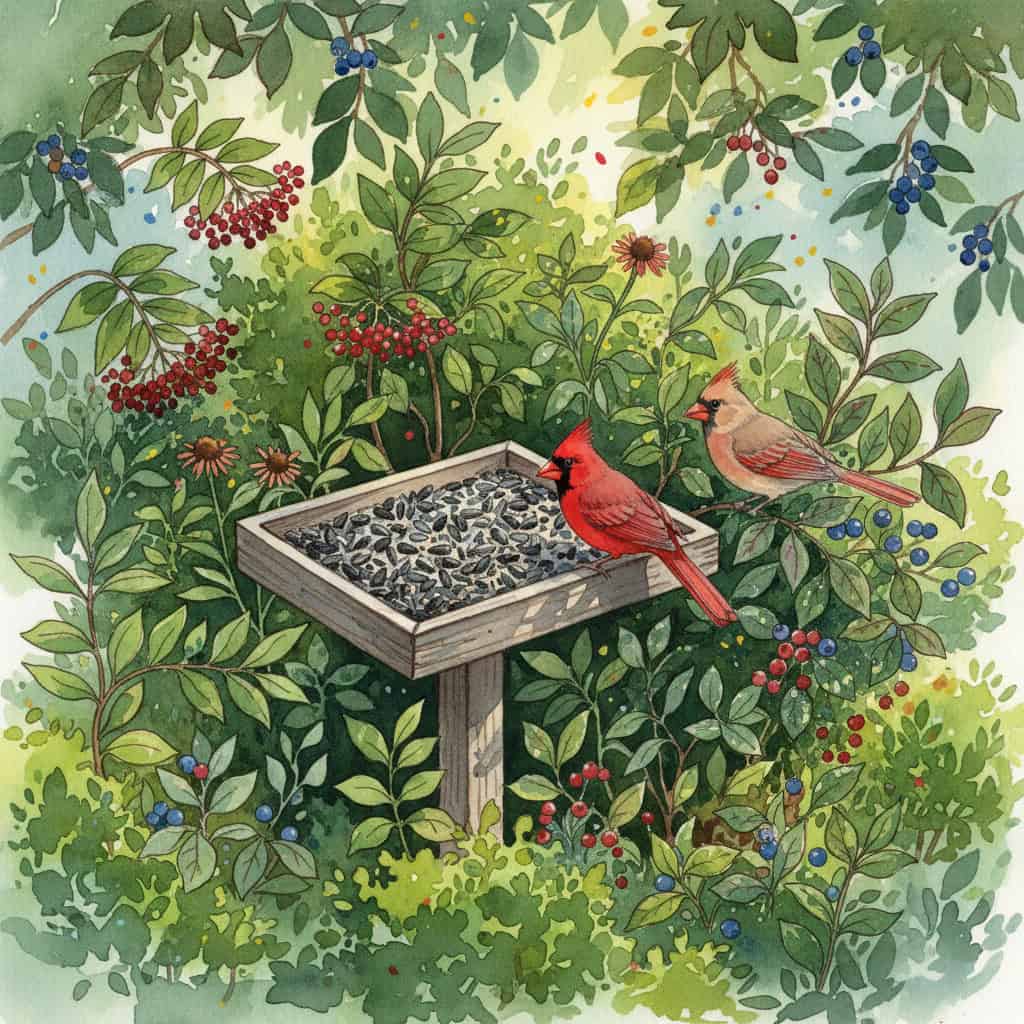
It is possible to see courtship feeding right in your backyard. With the proper resources and setup, you will be able to attract cardinals. They are generalist habitats and can be found all over the eastern United States as well as the Southwest and part of the Midwest. They will come to your feeders as long as their preferred resources are available.
Let's begin with foods that the cardinals enjoy. A great option is the black oil sunflower seeds. These seeds are very nutritious, and cardinals are able to easily crack open the seeds with their strong beaks. They are also able to break open the seeds with ease, and because of this, are able to gain the phenomenal nutritional benefits that support in breeding season. Safflower seeds are another great option. They are nutritionally good for cardinals and are less appealing to squirrels and other types of birds. The best type of feeders to use for cardinals are platform type feeders and also large hopper feeders. This is because cardinals like to have a nice and stable place to feed from where they can have a place to perch.
You can add to your seed offerings with native berry-producing shrubs. Cardinals love the fruit produced by dogwood, serviceberry, elderberry, and viburnum, and these shrubs create natural foraging opportunities that help mimic a cardinals’ wild habitat. During breeding season, having multiple food sources means the males are able to quickly gather food for the females.
Birdbaths are as attractive to birds as feeders, and keep the birds health and hygiene needs in mind. Fill the birdbath with fresh, shallow (<2") water at a regular interval to stave off mosquito larvae. In the spring and summer months, ensure that you are changing the water every day to prevent mosquitos from laying eggs. Even in the colder months, birds will be attracted to your yard if you have a heated birdbath in the winter, as this will create a sanctuary for birds during the colder months.
Lastly, we should also discuss cover and nesting habitats. Nesting habitats are dense shrubbery and small tree species, Cardinal nests are typically 3 to 10 feet off the ground so evergreens like juniper or holly are excellent sheltering options. Native shrub thickets offer the best nesting options, so the more vertical natural structure you provide, the greater the chances a cardinal pair will take up residence providing wonderful viewing of the cardinal's breeding behaviors.
Watching a male cardinal feed his partner is a romantic sight right? Well, it is a little more involved than a simple courtship behavior. It is a feeding behavior which, from an evolutionary perspective, greatly benefits the male. Each seed he feeds his mate is a potential offspring that will begin life with a unique advantage when compared to the other cardinals in the area.
Happy birding!